
July 1'st Week
Print PDF
General Studies II
Secular Foundations of the Indian Constitution: Beyond the Preamble
Tags :
News Context: –
• Recent political discourse has reignited debates over the legitimacy of incorporating the terms “socialist” and “secular” into the Preamble through the 42nd Amendment in 1976.
Historical Background of the 42nd Amendment
Political Context Behind the Amendment:
• Enacted during the Emergency under Prime Minister Indira Gandhi; often called the “Mini-Constitution”.
• Marked by Indira Gandhi’s leftward economic shift, including: Nationalisation of banks, Abolition of privy purses.
• Emergence of strong political opposition, especially from the Bharatiya Jana Sangh (now BJP).
• Aimed at justifying the Emergency as a means to preserve national unity and authority.
Key Features of the 42nd Amendment (1976):
• Added the words “Socialist” and “Secular” to the Preamble.
• Introduced “Integrity” to strengthen the ideal of fraternity.
• Inserted Fundamental Duties into the Constitution (Part IVA).
• Expanded the Directive Principles of State Policy.
• Reduced the powers of the judiciary, especially regarding judicial review.
• Froze the delimitation of parliamentary constituencies until 2000.
Aftermath:
• Many provisions were rolled back by the 44th Amendment (1978) under the Janata Party government.
• However, the additions to the Preamble— “Secular” and “Socialist”—were retained, indicating their long-term constitutional significance.
Constitutional Provisions Beyond the Preamble Reflecting Secularism: –
Fundamental Rights (Part III)
• Article 14: Guarantees equality before law and equal protection of laws; the State cannot favor or discriminate based on religion.
• Article 15: Prohibits discrimination on grounds of religion, race, caste, sex, or place of birth in public spaces.
• Article 16: Ensures equality of opportunity in public employment, explicitly prohibiting discrimination on religious grounds.
• Article 19(1)(a): Protects freedom of speech and expression, allowing peaceful articulation of religious beliefs.
• Article 25: Secures freedom of conscience and the right to freely profess, practice, and propagate religion.
• Article 26: Grants religious denominations the right to manage their own affairs in matters of religion.
• Article 27: Forbids compulsion of citizens to pay taxes that are used for the promotion or maintenance of any particular religion.
• Article 28: Restricts religious instruction in institutions wholly maintained out of State funds, ensuring secular public education.Directive Principles of State Policy (Part IV)
• Article 44: Directs the State to secure a Uniform Civil Code (UCC) for all citizens, promoting equality irrespective of religious practices in civil matters like marriage and inheritance.Fundamental Duties (Part IVA)
• Article 51A(e): Calls upon citizens to promote harmony and the spirit of common brotherhood transcending religious differences.
• Article 51A(f): Emphasizes the duty to value and preserve the rich heritage of India’s composite culture, rooted in religious diversity.Other Related Provisions
• Article 25(2): Allows the State to regulate or restrict secular activities associated with religious practice, such as temple administration or banning harmful customs.
• Article 29 and 30: Protect the rights of religious and linguistic minorities to conserve their culture and establish educational institutions.
• Article 290A: Provides for payment of certain sums to religious institutions, but this is administered without religious favouritism, reflecting neutral support.
Judicial Interpretation of Secularism: –
• Kesavananda Bharati v. State of Kerala (1973): The Supreme Court held that secularism is part of the Basic Structure of the Constitution, which cannot be amended by Parliament.
• S.R. Bommai v. Union of India (1994): The Court gave an extensive interpretation of secularism, stating that the State has no religion, and secularism means treating all religions equally and protecting religious minorities.
• Aruna Roy v. Union of India (2002): The Court clarified that secularism does not mean hostility towards religion but denotes equal treatment of all religions by the State.
• M.P. Gopalakrishnan Nair v. State of Kerala (2005): The Court reiterated that secularism under the Indian Constitution stands for tolerance, equality, and equal treatment of all religions.
• Recent 2024 Court judgement: Recently the Supreme Court dismissed petitions challenging the constitutional validity of the 42nd amendment by which the words ‘secular’ and ‘socialist’ were added to the Preamble of the Constitution during the Emergency days in 1976.
Challenges to Secularism in India: –
• Communalism and polarization: Rise of identity-based mobilization and communal rhetoric during elections weakens the secular fabric.
• Majoritarianism: Attempts to impose majority religious values on minorities leads to alienation and exclusion.
• Religious violence: Mob lynchings, riots, and targeted attacks against communities disrupt social harmony.
• State involvement in religion: Government control of temples and funding of pilgrimages blurs the line between State and religion.
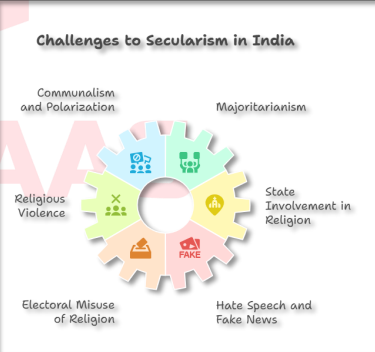
• Electoral misuse of religion: Use of religious symbols and appeals in campaigns violates the spirit of secular democracy.
• Hate speech and fake news: Digital platforms are used to spread misinformation and incite communal hatred.
Way Forward: –
• Strict enforcement of constitutional provisions: Uphold Articles 14, 15, 25–28 through proactive judicial and administrative action.
• Depoliticization of religion: Ensure strict implementation of the Representation of People Act, 1951 to curb use of religion in elections.
• Promote civic nationalism: Focus on shared constitutional values rather than religious identity to build inclusive citizenship.
• Reform of personal laws: Move gradually towards a Uniform Civil Code ensuring gender justice while respecting diversity.
• Digital regulation against hate speech: Enforce stronger monitoring of social media platforms to curb communal misinformation.
• Responsible media conduct: Enforce media ethics to prevent sensationalism and hate propagation in religious matters.
Conclusion: –
• The incorporation of the terms “socialist” and “secular” into the Preamble through the 42nd Amendment has long been debated, particularly concerning its constitutional legitimacy. However, the Supreme Court has reaffirmed that the inclusion of “socialist” and “secular” in the Preamble has gained widespread acceptance and does not impede governance or legislation. Instead, these terms reflect the core values of the Constitution and continue to guide India’s democratic and inclusive framework.
Question for Practice: –
• How is secularism reflected in the Indian Constitution beyond its mention in the Preamble? Illustrate with relevant provisions and judicial interpretations. (150W-10M)
Five Years of NEP 2020: Assessing the Progress of NIPUN Bharat
Tags :
News Context: –
• As NEP 2020 completes five years, its flagship initiative NIPUN Bharat enters a critical phase. It is now time to evaluate its early outcomes and future direction.
What is NIPUN Bharat?
• NIPUN (National Initiative for Proficiency in Reading with Understanding and Numeracy) Bharat operationalises NEP’s foundational learning goals.
• Target: Ensure that every child in Grades 1–3 attains foundational skills in reading and arithmetic by Grade 3.
• Launched by the Ministry of Education in July 2021 as part of the Samagra Shiksha programme.
• With ₹2,700 crore annual funding, it is the world’s largest foundational learning programme, reaching over 5 crore children and 17 lakh teachers across 6 lakh schools.
Key Features of the Mission: –
• Direct funding design: Allocates ₹500 per student/year for teaching-learning materials (TLMs), and ₹150 per teacher for training and resources.
• State-led implementation: Allows flexibility for states to adapt FLN tools (e.g., student workbooks, structured lesson plans).
• District-level empowerment: Strengthening district FLN units for tracking, mentoring, and assessment (e.g., 4 lakh assessments in UP, 57,000 classroom visits in Odisha).
• Monitoring mechanisms: Annual assessments like ASER and Foundational Learning Study track progress and learning outcomes.
Achievements So Far: –
Positive learning outcomes: Madhya Pradesh saw a 10% increase in students’ oral reading fluency between 2023 and 2024. ASER 2024 recorded the strongest FLN gains in two decades, with a 7% rise in Grade 3 students’ literacy and numeracy from 2022 to 2024.
High fund utilization: Nearly 100% of allocated funds are being used by states, indicating demand and momentum.
Structured classroom reforms: Use of workbooks, teacher guides, and digital tools has improved classroom engagement and pedagogical delivery.
Challenges in Implementation: –
• Inconsistent quality across states: Some states have advanced rapidly, while others lag in capacity building and monitoring.
• Overburdened teachers: Administrative duties and understaffing affect classroom implementation quality.
• Digital divide: Use of EdTech in classrooms is uneven due to infrastructure gaps.
• Need for early childhood support: Balvatika (pre-school) coverage is limited, affecting school readiness.
Way Forward: Towards NIPUN 2.0: –
• Extend mission timeline beyond 2027: To solidify gains and ensure long-term impact, NIPUN should continue for another five years.
• Broaden coverage: Expand to cover Balvatika to Grade 5, ensuring early preparedness and sustained learning gains.
• Strengthen district FLN units: Provide continuous funding and institutional accountability through state-level reviews.
• Institutionalize annual diagnostics: Build system-wide assessments (e.g., oral FLN assessments) to detect learning gaps early.
• Community and political ownership: Gram Sabhas, panchayats, and parents must be engaged in spreading awareness and tracking outcomes.
Conclusion: –
• The success of NIPUN Bharat so far shows what is possible when the education system puts learning at the center. But early progress must not lead to complacency. As India aspires for a Viksit Bharat by 2047, ensuring foundational learning for every child is non-negotiable. As Dr. A.P.J. Abdul Kalam rightly said, “Learning gives creativity, creativity leads to thinking, thinking provides knowledge, and knowledge makes you great.” In many ways, NIPUN Bharat has laid out the foundational tracks for this journey.
Question for Practice: –
• The NIPUN Bharat Mission reflects a systemic shift in prioritising foundational literacy and numeracy, but sustaining its momentum requires structural reforms and community ownership.” Discuss.
National Sports Policy-2025 Empowering citizens through sports
Tags :
News Context:
• The Union Cabinet on Tuesday (July 1, 2025) approved the National Sports Policy 2025.
• National Sports Policy is a landmark initiative aimed at reshaping the country’s sporting landscape and empowering citizens through sports.
Vision of the Policy:
• Replacing the 2001 policy with a comprehensive roadmap to make India a global sporting powerhouse, targeting success at the 2036 Olympics, and achieving Top-5 status by 2047.
• Developed through consultations with NITI Aayog, ministries, states, sports federations, athletes and experts.
Five Strategic Pillars:
Excellence on the Global Stage: Early talent scouting, competitive leagues, high-performance centres; improved governance of NSFs, upgraded coaching, and full integration of sports science, technology and analytics.
Sports for Economic Development: Leveraging sports tourism, hosting global events, boosting sports manufacturing; enabling sports startups, encouraging CSR and PPP investments, new funding models.
Sports for Social Development: Promoting inclusion of women, weaker sections, tribal communities, PwDs; reviving indigenous games and enabling diaspora and volunteering engagement.
Sports as a People’s Movement: Nationwide fitness campaigns, fitness indices in schools/colleges/workplaces; ensuring universal access to facilities and community-level engagement.
Integration with Education (NEP 2020): Embedding sports into curricula, training educators, enabling dual-career pathways for student-athletes.
Strategic & Institutional Framework:
Governance Reforms: National Sports Governance Bill 2025 (proposed) – establishes National Sports Board, brings NSFs under RTI, introduces term limits, regulates BCCI, sets up National Sports Election Panel.
Institutional Coordination: States encouraged to adopt Model State Sports Policy; mainstreaming sports across ministries; inter-ministerial coordination for grassroots implementation.
Funding & Incentives: Mobilization through PPPs, CSR, startup support; tax benefits and infrastructure incentives for investors.
Monitoring & Technology: AI-based athlete management dashboards, performance tracking, transparent outcome-based funding.
Evolution of Sports Policies:
National Sports Policy 1984: Focus on physical fitness, rural/indigenous games, creation of SAI, 3-tier structure (school–college–elite).
National Sports Policy 2001: Broad participation + international excellence; partnerships with states/NGOs/private sector; infrastructure development, talent identification, incentives for medal winners, women’s participation, Panchayat involvement.
Key Challenges:
• Uneven infrastructure and execution across states.
• Resistance from established sports bodies (BCCI) on transparency and oversight.
• Inclusion goals lack legal enforcement, risk of symbolism.
• Overdependence on private sector leading to urban-centric growth.
• Neglect of e-sports despite its growing importance.
• Complex monitoring with limited grassroots tech capacity.
• Weak sports research, biomechanics, coaching education ecosystem.
• Heavy elite-performance focus (Olympics 2036) may sideline community sports.
Way Forward:
• Incentivize states for Model Policy adoption with performance-linked aid.
• Legally enforce inclusion goals (women, PwDs, transgender athletes).
• Expedite Sports Governance Bill 2025 for transparency and accountability.
• Recognize and regulate e-sports, urban/adventure sports.
• Invest in sports science, biomechanics, nutrition, and training education with academic and global collaboration.
Conclusion:
The National Sports Policy 2025 marks a bold step in reimagining India’s sports landscape—from elite competitiveness to grassroots inclusiveness. Its alignment with education, economy, and national pride is commendable. Yet, its success hinges on strong governance, inclusive execution, and cultural transformation. If implemented effectively, it can transform sports into a force of nation-building and unlock India’s demographic dividend.
Question for Practice:
• The National Sports Policy 2025 aims to reform India’s sports ecosystem through structural and legal interventions. Discuss the key features of the policy and evaluate its potential in ensuring sports governance and inclusivity in India. (15 Marks, 250 words)
General Studies III
Gig Economy
Tags :
News Context:
• The Union government has, for the first time, permitted the use of bike taxis through aggregators, subject to approval from state governments.
• It is seen as bringing some relief to bike taxi operators, especially in states like Karnataka, where a recent ban on bike taxis had reportedly stripped thousands of gig workers of their primary source of income.
• Last year, Karnataka government published draft Karnataka Platform-based Gig Workers (Social Security and Welfare) Bill.
Definition:
• As per Code on Social Security, 2020, it means a person who performs work or participates in a work arrangement and earns from such activities outside of traditional employer-employee relationship.
• It is a free and global market where companies and contractors (independent workers) set short term and on demand professional relationships that are both flexible and skill based.
• Gig Worker: These are workers who are engaged “on demand” by the companies on short- term contacts or freelance work instead of full-time basis.
• Example – Zomato delivery, Uber Drivers
Two categories:
• Platform based: Whose work is based on online software apps or digital platforms. E.g., delivery workers of Zomato.
• Non-platform based: Casual wage workers in conventional sectors, working part-time or full-time. E.g., domestic workers.
Data and Facts
• There has been a rising share of gig workers in the economy at the rate of 20% in the overall hiring intent by employment type.
• According to NITI Aayog at present there are As of FY 2024–25, estimates suggest 9–11 million gig workers in India, with expectations to grow to 23.5 million by 2029-30.
• According to an estimate around 60% of the new employment is created by the gig world.
• India’s Gig Economy is expected to grow at a CAGR of 17% to $750 billion by 2025(ASSOCHAM).
Why Gig Worker Preferred in The Economy?
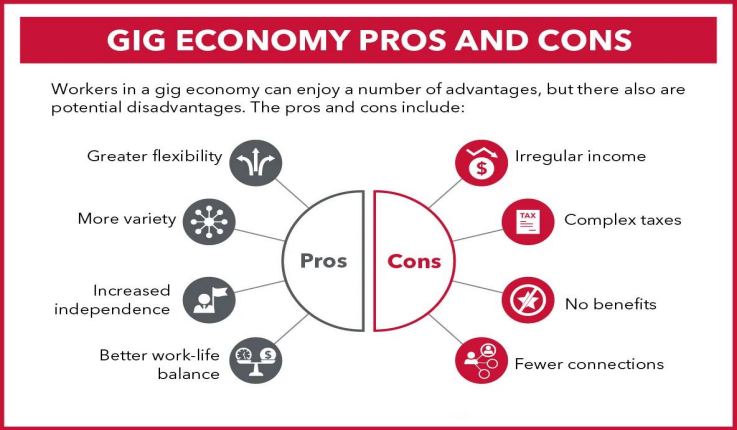
• Job Flexibility: Gig Economy offers flexible work hours and no attendance restrictions.
• Jobs for Low-skilled Workers: Gig Economy provides opportunities for low-skilled workers due to projectbased or less time-consuming jobs.
• Chance to Gain Experience: Students can gain skills and experience before entering full-time employment.
• No Age Barrier: The Gig Economy offers employment opportunities for both young and retired individuals.
• Beneficial for Women: Women can take career breaks and still earn independently through the Gig Economy.
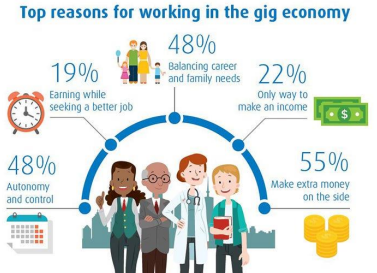
• Cost Efficiency for Employers: Hiring gig workers allows companies to reduce costs associated with full-time employees, such as benefits, insurance, and long-term commitments.
• Based on demand: Employers can scale their workforce based on demand without the overhead costs of permanent employment.
Factors Driving Growth of the Gig Economy in India:
Increased Smartphone and Mobile Penetration:
• The widespread use of smartphones and affordable internet access (India has the highest mobile data consumption per smartphone user globally) has enabled businesses to connect directly with gig workers through apps and online platforms.
Changing Work Preferences:
• Millennials and Gen Z prioritize work-life balance and flexibility, which the gig economy offers. Workers can choose their projects, set their schedules, and work from anywhere.
• Example: A graphic designer in Delhi can take on freelance projects on platforms like Upwork while pursuing a passion for photography, a flexibility not available in traditional 9-to-5 jobs.
Rise of Startup Culture and E-commerce Growth:
• India has seen a surge in startups, with over 16,000 new tech companies launched in 2020 alone. The flourishing startup ecosystem heavily relies on gig workers for tasks like content creation, web development, and marketing.
• E-commerce growth also demands a large, flexible workforce for logistics, delivery, and customer service roles, fueling the gig economy.
Consumer Demand for Convenience:
• As urban consumers demand more convenient and quick services, such as food delivery, e-commerce, and cab services, gig workers are increasingly needed to fill roles like delivery executives, drivers, and other on-demand services.
Abundance of Low-Cost Labor:
• Semi-skilled and unskilled labor makes up a significant portion of gig jobs in India. About 47% of gig work is in medium-skilled jobs, and 31% is in low-skilled jobs.
• India’s vast pool of semi-skilled and unskilled labor, combined with a lack of formal employment opportunities, fuels the gig economy. This labor surplus drives platforms to offer lower wages and often poor working conditions, contributing to growth.
Challenges for Gig Workers:
• Digital Divide: Limited access to internet services and digital technology restricts the ability of many workers, especially in rural areas, to participate in the gig economy.
• Data Protection Concerns: Platform companies often make opaque decisions about how they collect, store, and share personal data, impacting the Right to Privacy of gig workers.
• Lack of ‘Employee’ Status:
Gig workers are not considered employees, which leads to several issues, such as:
Inability to form unions to advocate for their rights.
Exploitative contracts and limited legal protections.
• Uncertain Nature of the Job: Gig workers face job insecurity, irregular wages, and an unpredictable employment status, making long-term financial planning difficult.
• Lack of Social Protection: Gig workers do not have access to standard employee benefits such as Health Insurance, Employees Provident Fund (EPF), or paid leave, leaving them vulnerable in times of need.
• Algorithmic Management: Many gig workers are subject to algorithmic management, where their performance is monitored and evaluated through algorithms. This can create stress and pressure to meet high performance standards based on ratings, without consideration for human factors.
Steps Taken for the Gig Economy in India:
• Code on Social Security, 2020: This code extends social security benefits to gig workers, ensuring they receive similar protections as formal employees.
• Code on Wages, 2019: Introduces a universal minimum wage and a floor wage that applies across both the organized and unorganized sectors, including gig workers.
• e-SHRAM Portal: A national database of unorganized workers, including gig workers, that helps in registration and delivery of social security benefits.
• Pradhan Mantri Suraksha Bima Yojana (PMSBY):
o Provides accidental insurance coverage of Rs. 2 lakh per year to eligible registered unorganized workers, including gig workers, offering financial protection in case of accidents.
o Centre for Labour Studies, National Law School of India University (NLSUI), Bangalore: Engaged to assist in framing a new scheme for gig and platform workers, as well as other unorganized sector workers.
o A Memorandum of Understanding (MoU) has been signed between the Employees Provident Fund Organization (EPFO) and NLSUI to support the development of these schemes.
Way Forward:
Proper Estimation of Gig Workers:
• Conduct separate enumeration exercises to accurately estimate the number of gig workers and understand their needs.
Skill Development for Platform Jobs:
• Promote outcome-based, platform-led models of skilling and job creation to address the specific needs of gig workers.
• Integrate employment and skill development portals (e.g., e-Shram, National Career Services, Udyam) with the ASEEM portal for better accessibility to jobs and training.
Universal Social Security Coverage:
• Extend social security measures to gig workers in a partnership mode as envisioned in the Code on Social Security, 2020.
• This should include paid sick leave, occupational disease and work accident insurance, retirement/pension plans, and other contingency benefits.
Tripartite Dialogue:
• Establish a tripartite dialogue between governments, platform unions, and employer-based organizations (EBMOs) to address labor issues and improve worker well-being in the platform economy.
Catalyze Platformization:
• Introduce a Platform India initiative (similar to Startup India) to promote platform-based businesses.
• This initiative could help self-employed individuals sell products, provide services, and expand market access, such as ferrying passengers or delivering goods.
Accelerate Financial Inclusion:
• Provide institutional credit to vulnerable gig workers by designing financial products specifically for them.
• Leverage the FinTech industry to improve access to financial services for platform workers.
Enhancing Social Inclusion in the Digital Economy:
• Enable marginalized groups, including women workers and persons with disabilities (PwDs), to access employment opportunities in the platform sector through skill development and financial access.
Conclusion:
• The gig economy offers flexibility but exposes workers to insecurity. Comprehensive measures like social security, skill development, and financial inclusion are essential for a sustainable and inclusive gig workforce in India.
Question for Practice:
• “Discuss the role of the gig economy in reshaping India’s labour market. What are the key challenges and opportunities associated with its growth?” (150W-10M)
Quantum Technology and India
Tags :
News Context:
• UN designated 2025 to be International Year of Quantum Science and Technology.
• As the global tech race intensifies, quantum technology is becoming crucial to digital, economic, and national security. India must now focus not just on investing in quantum capabilities but on forging strategic alignments to stay competitive.
About:
• Year 2025 was chosen as it recognizes 100 years since the initial development of quantum mechanics.
• German physicist Werner Heisenberg published a famous paper which led to the discovery of phenomena called quantum mechanics.
What is Quantum Mechanics and Quantum Entanglement?
• Mechanics is the branch of physics that deals with the movement and interaction of various bodies.
• Mechanics has two parts – classical and quantum.
• Classical or Newtonian mechanics is the mathematical study of the motion of macroscopic objects and the forces that affect them.
• Quantum mechanics is a subfield of physics that describes the behaviour of particles — atoms, electrons, photons and almost everything in the molecular and sub molecular realm.
• 2 basic principles of quantum mechanics are:
Quantum entanglement: It explains how two subatomic particles can be intimately linked to each other.
Quantum superposition: It is a theory that subatomic particles exist in multiple states simultaneously.
• One important difference in the behaviour of quantum systems, when compared to classical rigid bodies, is the concept of entanglement.
Quantum Entanglement:
• A phenomenon by which a pair of subatomic particles are allowed to exist in a shared state where they have complementary properties, such that by measuring the properties of one particle, one can automatically know the properties of the other particle.
• This is true regardless of how far apart the two particles are transported.
• Quantum entanglement was first elucidated by Erwin Schrödinger in 1935, leading to his well-known cat paradox.
Importance of Quantum Technology
• Massive Market Potential: By 2040, the global quantum technology market is projected to reach $100 billion, with the quantum communication segment alone expected to cross $13 billion by 2034.
• Power to Shape Global Rules: Nations that lead in quantum computing, encryption, and sensing will shape digital governance norms and global standards.
• Current Leaders: The US and China dominate the quantum race through control over high-end fabrication, cryogenic systems, and laser technologies.
• Strategic Edge: Nations that lead in quantum computing, encryption, and sensing will gain significant influence over global digital standards and cyber governance norms.
• Cybersecurity Importance: Quantum technology is essential for national security, as it enables Quantum Key Distribution (QKD), which provides virtually unhackable communication.
India’s Quantum Achievements:
• Progress in Quantum Ecosystem – Notable strides in hardware development and secure communication technologies.
• Indigenous Quantum Processor – Ajeya, India’s first 6-qubit superconducting quantum processor, developed by DRDO & TCS, designed at TIFR.
• Full-Stack Quantum Control – India’s first full-stack control system developed via DRDO–TCS collaboration.
• Quantum Communication Trials – Successful 100 km-long QKD trials via optical fibre (DRDO–IIT Delhi) and free space (ISRO–RRI).
• Quantum Sensing & Navigation – DRDO advancing quantum metrology for high-precision defence applications.
• Industry Contribution – Startups like Nav Wireless developing Free Space Optical Communication systems.
India’s Advantage in Quantum Technology:
• Strong Talent Base – Ranks 2nd globally with 91,000+ quantum-ready graduates.
• Mathematical Proficiency – Strengths in tensor algebra, Monte Carlo methods, and Fourier transforms.
• Cost-Effective Execution Model – Mission-mode and frugal engineering approach for low-cost scaling.
• Indigenous Capability Focus – National Quantum Mission (NQM) promotes local component development.
• Thriving Startup Ecosystem – Startups in secure communication, sensing, software simulation (e.g., QNu Labs, BosonQ Psi).
• Government Policy Support – Digital India, Atmanirbhar Bharat, NM-ICPS support quantum growth.
• Academic & R&D Strength – IISc, IITs, TIFR, RRI, IIT-Madras’s Quantum Centre lead research.
• International Collaborations – Partnerships with France, Finland, Israel, US etc.
Challenges for India:
• Scaling Challenges – Export restrictions and limited skilled engineers (NITI Aayog).
• Funding Deficit – Only 2.63% of research funded by industry; 17% remain unfunded.
• Human Capital Gap – Shortage of quantum engineers; brain drain due to lack of labs/funding.
• Supply Chain Dependency – No indigenous chip fabrication; import reliance for cryogenics, lasers, rare materials.
• Limited Global Integration – Few collaborations (e.g., Infosys–Quintessence Labs).
• Insignificant Private Sector Investment – Only $30 million vs USA ($6,940 million) & Australia ($661 million).
Government Initiatives:
• Budget Allocation – NQM ~₹6,000 crore.
• T-Hubs – Thematic Hubs at IISc, IIT Madras, IIT Bombay, IIT Delhi.
• Application Lab – MeitY’s QCAL for public-sector quantum applications.
• Startup Funding – $1.2 billion fund under RDI scheme for quantum & deep-tech.
• Talent Pipeline – QIndia & DST support education from school to UG levels.
Strategic Recommendations:
• Deepen Global Partnerships – US, EU, South Korea, Australia via India-US TRUST & Quantum Entanglement Exchange.
• Maximize NQM – Central framework for computing, communication, sensing, materials.
• Influence Global Standards – Engage in forums, set up a Quantum Standards Authority.
• Foster Startup Collaboration – Cross-border innovation via T-Hub, Seoul Startup Hub, INDUS-X.
• Identify & Bridge R&D Gaps – Map funding, talent, supply chain gaps; introduce talent visa schemes, lab autonomy.
Conclusion:
• Quantum technology is poised to redefine global technological leadership, with implications for defence, cybersecurity, and high-performance computing. The NQM reflects India’s intent to build indigenous capability and position itself among the top players by 2031.
• The Economic Survey 2020–21 identifies quantum as a top-10 priority sector with exponential economic returns.
• IISc & IIT-Madras experts emphasize India’s strengths in talent and cost-effective models but warn that without sustained investment and global collaboration, India may lag in hardware and standards.
Question for Practice:
• “Quantum technology has been identified as a priority sector in the Economic Survey and is central to India’s science diplomacy. Critically examine the role of expert institutions and government initiatives in building quantum capacity in India.” (250 words-10M)