July 2'nd Week
Print PDF
Enemy Property Act, 1968
Tags :
Context:
• The Madhya Pradesh High Court has recently rejected an objection filed by an actor against a government notification that declared his property as “enemy property” under the Enemy Property Act, 1968.
About the Enemy Property Act, 1968:
• The Act defines an ‘enemy’ as any country along with its citizens that has carried out external aggression against India, specifically referring to Pakistan and China.
• Enemy property refers to any assets that are, at any given time, owned by, or held or managed on behalf of, an enemy, enemy subject, or enemy firm.
• Such properties are vested in the Custodian of Enemy Property for India, under the Ministry of Home Affairs, who is responsible for managing and preserving them.
The 2017 amendment widened the scope of the term “enemy” to include:
• Legal heirs or successors of enemies, even if they are Indian citizens or citizens of countries that are not considered enemies.
• Individuals who were once designated as enemies but have subsequently changed their nationality.
Battery Passport
Tags :
Context:
• NITI Aayog has initiated discussions with ministries to develop a national framework for Battery Passport implementation.
About Battery Passport:
• A digital identity system for batteries, similar to Aadhaar.
• Assigns a unique ID, typically embedded in a QR code.
• Contains key data: origin, chemical composition, performance, and end-of-life information.
• Promotes a transparent and circular battery supply chain.
• Enhances safety, traceability, and quality compliance.
• Supports EV exports by aligning with global standards, such as the EU Batteries Regulation (2023).
Central Drugs Standard Control Organisation (CDSCO)
Tags :
Context:
• CDSCO has recommended that 17 drugs mainly narcotics like fentanyl, tramadol, and diazepam be safely disposed of through sinks to avoid harm to humans and pets.
About CDSCO:
• Acts as the Central Drug Authority under the Directorate General of Health Services, Ministry of Health & Family Welfare.
• Performs functions assigned to the Central Government under the Drugs and Cosmetics Act, 1940.
• While states regulate the manufacture, sale, and distribution of drugs, CDSCO is responsible for the approval of new drugs at the central level.
• It regulates drug imports, including licensing procedures.
• It oversees clinical trials.
• Can impose bans on drugs and cosmetics deemed unsafe.
• Organizes meetings of key advisory bodies like the Drugs Consultative Committee (DCC) and the Drugs Technical Advisory Board (DTAB).
VRRR Auction to Absorb Excess Liquidity
Tags :
Context:
• The Reserve Bank of India (RBI) will conduct a 7-day Variable Rate Reverse Repo (VRRR) auction amounting to ₹1 lakh crore to absorb excess liquidity from the banking system.
Key Facts about Variable Rate Reverse Repo (VRRR):
• VRRR is a liquidity absorption tool used by the RBI under its Liquidity Adjustment Facility (LAF).
• It allows banks to park excess funds with the RBI at a variable interest rate, determined through auction.
• Introduced in 2020, replacing fixed-rate reverse repo for short-term liquidity management.
• Helps the RBI sterilize surplus liquidity and maintain monetary stability.
Liquidity Adjustment Facility (LAF)
• Introduced by RBI in 2000 as a monetary policy tool.
• Recommended by Narasimham Committee II and Working Group on Money Market (1997).
• Helps manage short-term liquidity in the banking system.
• Comprises two main instruments: Repo (liquidity injection) and Reverse Repo (liquidity absorption).
• Repo Rate: Banks borrow from RBI by pledging government securities.
• Reverse Repo Rate: Banks park surplus funds with RBI to earn interest.
• Includes Variable Rate Reverse Repo (VRRR) for dynamic liquidity absorption via auction.
• Operated under the Liquidity Management Framework of RBI.
Nyangai Island
Tags :
Context:
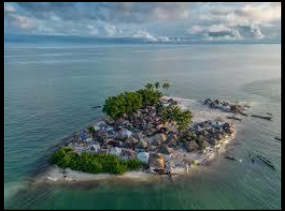
• In under a decade, Nyangai Island has lost two-thirds of its land area due to severe coastal erosion. It now measures only about 200 metres by 100 metres.
About:
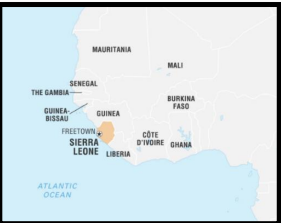
• A small island off the coast of Sierra Leone.
• Part of the Turtle Islands archipelago.
• Low-lying and located along a coastline prone to strong ocean currents.
• Naturally vulnerable to erosion, now facing accelerated land loss.
• A notable example of climate-induced geographical change affecting small island ecosystems.
Sierra Leone
• Location: West Africa, along the Atlantic Ocean.
• Borders: Shares land borders with Guinea (north and east) and Liberia (southeast).
• Geographical Features: Coastal country with low-lying islands, mangroves, and tropical forests.
• Official Language: English
• Colonial History: Former British colony; gained independence in 1961.
• Economy: Rich in diamonds, bauxite, and titanium; agriculture and mining are key sectors.
Bluetooth Low Energy Mesh Networking
Tags :
Context:
• BitChat, a new peer-to-peer messaging app, uses Bluetooth Low Energy Mesh Networking to operate without a central server or mobile network.
What is Bluetooth Mesh Networking?
• A network topology where multiple Bluetooth devices form a mesh by connecting to nearby devices.
• Also known as a multi-hop network, enabling data to pass through several intermediate nodes.
• Supports many-to-many communication among devices.
• Each device in the mesh becomes a node once it joins the network.
• Messages are broadcast and relayed by nodes until reaching the intended recipient.
• Network remains functional even if one or more devices fail.
• Utilizes Bluetooth Low Energy (BLE), ensuring low power usage.
Accelerator Mass Spectrometry (AMS) Dating
Tags :
Context:
• The Tamil Nadu State Department of Archaeology (TNSDA) has sent 23 charcoal samples to the Beta Analytic Laboratory, USA for AMS dating.
What is Accelerator Mass Spectrometry (AMS) Dating?
• A precise technique for measuring Carbon-14 (C14) isotope levels in samples.
• Involves accelerating ions to extremely high kinetic energies.
• Followed by mass analysis to identify atoms based on atomic weights.
• Used mainly for determining the C-14 content in archaeological and geological samples.
• Helps detect and measure specific isotopes with high accuracy.
• Consists of two main steps: ion acceleration and mass spectrometric detection.
Broadcasting Infrastructure and Network Development (BIND) Scheme
Tags :
Context:
• The Central Government will set up an Akashvani Kendra in Ujjain under the BIND scheme.
What is BIND Scheme?
• It is a Central Sector Scheme.
• Provides financial support to Prasar Bharati (All India Radio and Doordarshan).
• Covers expansion, upgradation, and modernization of broadcasting infrastructure.
• Supports content development and civil works related to AIR and DD.
• Enables upgradation in LWE (Left Wing Extremism), border, and strategic areas.
• Focuses on creating high-quality content for domestic and international audiences.
• Aims to enhance DTH platform capacity to allow more channels and diverse content.
Prasar Bharati
• India’s public service broadcaster.
• Established under the Prasar Bharati Act, 1990.
• Functions as an autonomous statutory body.
• Comprises All India Radio (AIR) and Doordarshan (DD).
• Operates under the Ministry of Information and Broadcasting.
• Mandated to ensure impartial, diverse, and inclusive broadcasting.
• Funded through government grants, advertisements, and internal revenue.
• Plays a key role in public awareness, education, and national integration.
Nistar
Tags :
Context:
• ‘Nistar’, India’s first indigenously designed and built Diving Support Vessel, was recently delivered by Hindustan Shipyard Limited to the Indian Navy at Visakhapatnam.
About Nistar:
• First indigenously designed and constructed Diving Support Vessel.
• Built by Hindustan Shipyard Limited.
• Name ‘Nistar’ is derived from Sanskrit, meaning liberation, rescue, or salvation.
• Built as per classification rules of Indian Register of Shipping (IRS).
• Contains nearly 75% indigenous content.
• Aligned with Aatmanirbhar Bharat and Make in India initiatives.
TALASH Initiative
Tags :
Context:
• Recently, the National Education Society for Tribal Students (NESTS), an autonomous organization under the Ministry of Tribal Affairs, launched the TALASH initiative.
About TALASH:
• Launched by NESTS in collaboration with UNICEF India.
• Aims to promote holistic development of students in Eklavya Model Residential Schools (EMRSs).
• TALASH stands for Tribal Aptitude, Life Skills and Self-Esteem Hub.
• Focuses on self-awareness, life skills, and career clarity among tribal students.
• Targets over 1.38 lakh EMRS students across 28 States and 8 UTs.
• A digital platform offering psychometric tests, career guidance, and life skills training.
• Aligned with the vision of NEP 2020 for inclusive and equitable education.
Eklavya Model Residential Schools (EMRSs)
• An initiative under the Ministry of Tribal Affairs.
• Launched in 1997-98 to provide quality education to Scheduled Tribe (ST) students.
• Fully residential schools from Class VI to XII.
• Aimed at promoting educational and holistic development in tribal-dominated areas.
• Set up in blocks with at least 50% ST population and 20,000 tribal persons.
• Run by National Education Society for Tribal Students (NESTS).
• Focus on STEM education, sports, skill development, and extracurricular activities.
• Free boarding, lodging, uniforms, textbooks, and coaching support provided.
Enforcement Case Information Report (ECIR)
Tags :
Context:
• The Enforcement Directorate (ED) recently registered an ECIR against 29 individuals, including actors and influencers, for allegedly promoting illegal betting apps.
About Enforcement Case Information Report (ECIR):
• ECIR is a formal complaint entry registered by the Enforcement Directorate (ED).
• Filed when ED receives information related to money laundering offences.
• Initiates ED’s proceedings, such as asset attachment and arrests.
• Not mentioned in the Prevention of Money Laundering Act (PMLA), 2002 or its rules.
• Considered a non-statutory document, unlike an FIR.
• ED registers ECIR as an internal procedural document before taking action under PMLA.
• Not required to be shared with the accused, unlike FIRs.
• Supreme Court has ruled that ECIR is not equivalent to an FIR.
• No legal provision for quashing an ECIR, since it holds no statutory basis.
• Primarily used for case identification and departmental convenience.
Enforcement Directorate (ED)
• A law enforcement agency under the Department of Revenue, Ministry of Finance.
• Established in 1956 to investigate economic crimes.
• Mandated to enforce two key laws: 1. Prevention of Money Laundering Act (PMLA), 2002 and 2. Foreign Exchange Management Act (FEMA), 1999
• Empowered to investigate, attach properties, arrest, and prosecute in money laundering cases.
• Can also conduct search and seizure operations under PMLA.
• Headquarters: New Delhi
• Headed by a Director, appointed under the Central Vigilance Commission Act, 2003.
Lake Turkana
Tags :
Context:
• Recently, scientists extracted 18–20-million-year-old enamel proteins from extinct mammal fossils found in the Lake Turkana Basin.
About Lake Turkana:
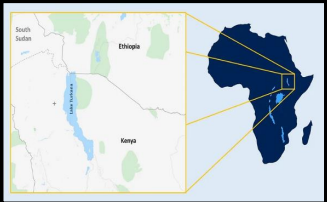
• Located in northern Kenya, with the northern tip extending into Ethiopia.
• Lies in the Eastern Rift Valley.
• Fed by three rivers: Omo (perennial, contributes ~90% of inflow), Turkwel, and Kerio.
• Africa’s 4th-largest lake and the largest permanent desert lake in the world.
• Designated as a UNESCO World Heritage Site.
• Known for its biodiversity and archaeological significance.
• Situated in a hot, arid, and remote region.
• Supports ~1 million people, mostly engaged in pastoralism, fishing, and subsistence farming.
Autonomous District Councils
Tags :
Context:
• Governor’s rule has been imposed in the Chakma Autonomous District Council in Mizoram under the provisions of the Sixth Schedule of the Constitution.
What are Autonomous District Councils (ADCs)?
• Administrative bodies set up under the Sixth Schedule of the Constitution.
• Function in tribal areas of Assam, Meghalaya, Tripura, and Mizoram.
• Aim to provide self-governance to tribal communities.
• Preserve tribal identity, customs, and promote local development.
• Empowered to make laws on land, forests, customs, and local governance.
• Have judicial powers to adjudicate disputes using customary laws.
• Support the establishment of village and district council courts.
• Typically consist of up to 30 members, with maximum 4 nominated by the Governor.
Indigenous MALE Drones
Tags :

Context:
• India to procure 87 indigenously developed MALE (Medium Altitude Long Endurance) drones, featuring at least 60% indigenous content, under the Make in India initiative.
About :
• First-time private Indian firms are assigned to supply MALE drones, replacing earlier imports from Israel.
• Provide over 30 hours endurance at altitudes up to 35,000 feet.
• Designed for ISR roles – Intelligence, Surveillance & Reconnaissance.
• Will enhance security along sea and land borders.
• Aligned with Atmanirbhar Bharat and defence indigenization goals.
• Other indigenous Drones: Lakshya, Nishant, RUSTOM-1, TAPAS/Rustom-2, Archer
Astra Missile
Tags :
Context:
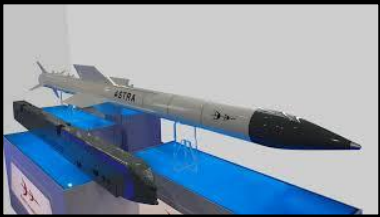
• Recently, DRDO and the Indian Air Force (IAF) successfully conducted the flight test of the Astra missile.
About Astra Missile:
• It is an indigenously developed Beyond Visual Range Air-to-Air Missile (BVRAAM).
• Developed by DRDO with contributions from over 50 public and private industries, including HAL.
• Integrated with Su-30 Mk-I fighter aircraft.
• Equipped with indigenous Radio Frequency (RF) Seeker developed by DRDO.
Maratha Military Landscapes of India
Tags :
Context:
• Recently, the ‘Maratha Military Landscapes of India’ was inscribed on the UNESCO World Heritage List, becoming India’s 44th World Heritage Site.
About
• Comprises 12 forts dating from the 17th to 19th centuries CE.
• Showcases the military strategy and architectural excellence of the Maratha Empire.
• Spread across Maharashtra and Tamil Nadu.
• In Maharashtra: Salher, Shivneri, Lohgad, Khanderi, Raigad, Rajgad, Pratapgad, Suvarnadurg, Panhala, Vijaydurg, Sindhudurg
• In Tamil Nadu: Gingee Fort
• Protected by Archaeological Survey of India (ASI): Shivneri, Lohgad, Raigad, Suvarnadurg, Panhala, Vijaydurg, Sindhudurg, Gingee Fort
• Protected by Directorate of Archaeology and Museums, Government of Maharashtra: Salher, Rajgad, Khanderi, Pratapgad.
What are UNESCO World Heritage Sites (WHS)?
• Designated by UNESCO (United Nations Educational, Scientific and Cultural Organization).
• Recognizes sites of cultural, natural, or mixed (both) significance to humanity.
• Governed by the 1972 UNESCO World Heritage Convention.
• India ratified the convention in 1977.
• A site must be of Outstanding Universal Value (OUV) to qualify.
• Nominated sites must meet at least one out of ten selection criteria set by UNESCO.
• Once inscribed, WHS are monitored and periodically reviewed by the World Heritage Committee.
• First Indian sites inscribed in 1983: Ajanta Caves, Ellora Caves, Agra Fort, and Taj Mahal.
International Criminal Court (ICC)
Tags :
Context:
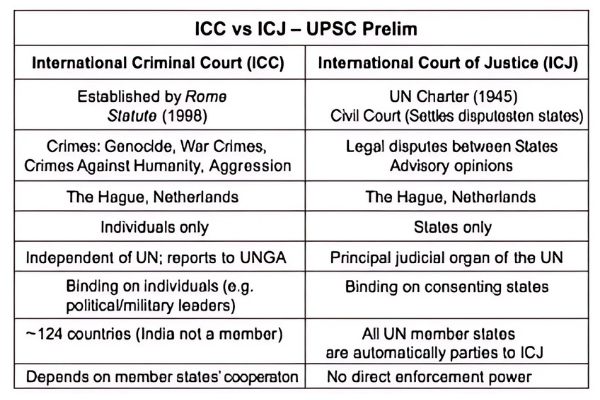
• The International Criminal Court (ICC) has issued arrest warrants against Taliban leaders under Article 7(1)(h) of the Rome Statute for crimes against humanity, citing systematic gender and political persecution in Afghanistan.
About:
• ICC is the world’s first permanent international criminal court to prosecute individuals for serious international crimes.
• Established under the Rome Statute, adopted on 17 July 1998 and in force since 1 July 2002.
• Headquartered in The Hague, Netherlands.
• Has jurisdiction over Genocide, Crimes against Humanity, War Crimes, and Crime of Aggression.
• Tries crimes only when national jurisdictions are unwilling or unable to prosecute.
• Jurisdiction applies in member states or non-member states if referred by the UN Security Council.
• The Rome Statute has been ratified by 125 countries; India, USA, China, Israel are not members.
• ICC lacks its own police; depends on voluntary cooperation from member states for enforcement.
International Financial Services Centres Authority (IFSCA)
Tags :
Context:
• The largest privately owned bank in Taiwan, CTBC Bank, has applied to the International Financial Services Centres Authority (IFSCA) to set up an IFSC Banking Unit (IBU) in GIFT City.
About:
• A statutory authority established under the IFSCA Act, 2019.
• Serves as a unified regulator for financial services, products, and institutions in India’s International Financial Services Centres (IFSCs).
• Aims to develop a global financial hub, aligning with India’s economic needs and regional financial integration.
• Prior to IFSCA, regulation was handled by domestic regulators like RBI, SEBI, IRDAI, and PFRDA.
• Headquartered at GIFT City, Gandhinagar, Gujarat – currently the only operational IFSC in India.
Membership:
• Composed of 9 members appointed by the Central Government
• Chairperson
• 1 member each from RBI, SEBI, IRDAI, PFRDA
• 2 members from the Ministry of Finance
• 2 members appointed on Selection Committee recommendation
• Tenure: All members hold office for three years, eligible for reappointment.
Blackbuck
Tags :
Context:
• Wildlife officials have reported a sharp decline in the blackbuck population in the Abohar Wildlife Sanctuary, Punjab.
About:
• A species of antelope native to India and Nepal.
• Scientific Name: Antilope cervicapra
• Found across Rajasthan, Gujarat, Madhya Pradesh, Tamil Nadu, Odisha, and other regions of peninsular India.
• Declared as the State Animal of Punjab, Haryana, and Andhra Pradesh.
• Inhabits open grasslands, dry scrublands, and lightly forested areas.
• IUCN Red List: Least Concern
• Wildlife Protection Act, 1972: Schedule I
• CITES: Appendix III