
July 4'th Week
Print PDF
Impeachment Process of Judges in India
Tags :
Context:
• The Union Parliamentary Affairs Minister stated that more than 100 Members of Parliament (MPs) have endorsed a notice to initiate impeachment proceedings against Justice Yashwant Varma.
About: Impeachment Process of Judges in India
• Constitutional Provision: Mentioned under Article 124(4) & (5) for Supreme Court judges; applicable to High Court judges under Article 217 read with Article 124.
• Grounds: Proven misbehaviour or incapacity.
• Initiation: Motion can be introduced in either House of Parliament, supported by at least 100 MPs in Lok Sabha or 50 MPs in Rajya Sabha.
• Inquiry Committee: After admission, the Speaker/Chairman forms a 3-member committee — a Supreme Court judge, a High Court Chief Justice, and a distinguished jurist — to investigate charges.
• Parliamentary Approval: If the committee finds the judge guilty, each House must pass the motion by special majority —
o Majority of total membership, and
o Majority of not less than two-thirds of members present and voting.
• Presidential Action: Once both Houses pass the motion, the President issues an order for removal.
• Notable Case: Justice V. Ramaswami (1993) motion failed in Lok Sabha despite proven charges due to lack of required majority.
75 Years of National Sample Survey (NSS)
Tags :
Context:
• The National Sample Survey (NSS) is celebrating its 75th year with the theme “NSS – A Glorious Past to a Promising Future for a Viksit Bharat.”
About National Sample Survey (NSS)
• Established in 1950 by statistician P.C. Mahalanobis.
• Collects nationwide economic and social data using random sampling methods.
• Functions under the Ministry of Statistics and Programme Implementation (MoSPI).
• Currently, NSS functions as a survey division within NSO since the 2019 reorganisation.
• Headed by a Director General responsible for large-scale sample surveys on an all-India basis.
National Statistical Office (NSO)
• Formed in 2019 by merging the National Sample Survey Office (NSSO) and the Central Statistics Office (CSO).
• Responsible for coordinating and maintaining statistical standards across government agencies.
• Conducts large-scale socio-economic surveys, including the Periodic Labour Force Survey (PLFS) and Annual Survey of Industries (ASI).
• Prepares and releases key economic indicators such as the Gross Domestic Product (GDP), Index of Industrial Production (IIP), and Consumer Price Index (CPI).
• Publishes the National Accounts Statistics and various statistical reports for policymaking and research.
About P.C. Mahalanobis
• Renowned Indian statistician and founder of the Indian Statistical Institute (ISI).
• Architect of India’s Second Five-Year Plan (emphasised heavy industries).
• Developed the Mahalanobis Distance — a statistical measure widely used in classification and cluster analysis.
• Pioneer in introducing large-scale sample surveys in India through the NSS.
Kamchatka Peninsula
Tags :
Context:
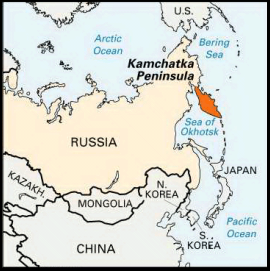
• Recently, five earthquakes struck near the east coast of the Kamchatka Peninsula in Russia, a tectonically active region, with the strongest measuring 7.4 in magnitude.
About Kamchatka Peninsula
• Located on the Pacific Ring of Fire, between the Sea of Okhotsk (west) and the Pacific Ocean & Bering Sea (east).
• Situated at the junction of the Pacific and North American tectonic plates, making it a highly active seismic zone.
• Features two main mountain ranges: Sredinny and Vostochny.
• Drained by the Kamchatka River, the primary waterway of the region.
• Known for significant volcanic and geothermal activity, hosting the Volcanoes of Kamchatka, a UNESCO World Heritage Site.
1,000 Years of Rajendra Chola I's Maritime Expedition
Tags :
Context:
• The Ministry of Culture is celebrating the Aadi Thiruvathirai Festival to mark the 1,000th anniversary of Rajendra Chola I’s maritime expedition to Southeast Asia.
About: Aadi Thiruvathirai Festival & Nayanar Bhakti Tradition
• Aadi Thiruvathirai is a traditional Tamil festival celebrated in the month of Aadi (July–August) on the day when the Thiruvathirai (Ardra) star rises.
• The festival also honours the Tamil Shaiva Bhakti traditions, especially the 63 Nayanars, saint-poets supported by the Chola dynasty.
• Dedicated to Lord Shiva in his Nataraja (cosmic dancer) form, symbolising the rhythm of the universe.
• Special rituals and processions are conducted in temples such as the Chidambaram Nataraja Temple.
• These Shaivite saint-poets lived between the 6th and 8th centuries CE and spread devotion to Lord Shiva through hymns and songs.
• Their works are compiled in the Tirumurai, the sacred Tamil Shaivite canon.
• The Chola rulers, particularly Rajaraja Chola I and Rajendra Chola I, greatly patronised the Nayanar tradition, building temples and promoting Shaiva worship.
About: Chola Empire
• Capital: Thanjavur.
• Major Rulers: Rajaraja Chola I, Rajendra Chola I.
• Naval Expeditions: Rajendra Chola I launched India’s first major overseas naval expedition (~1025 CE) against the Srivijaya Empire in Southeast Asia.
• Temples: Built the Brihadisvara Temple (Thanjavur) – UNESCO World Heritage Site.
• Administration: Advanced revenue system, local self-governance through Sabhas, Ur, and Nadu.
• Art & Culture: Bronze sculpture, Tamil literature, and temple architecture thrived under their patronage.
5. NASA–ISRO Synthetic Aperture Radar (NISAR) Satellite
Tags :
Context:
• NISAR, the first joint Earth-observation satellite by NASA and ISRO, launched on July 30 at 5:40 p.m. aboard GSLV-F16 from Satish Dhawan Space Centre, Sriharikota.
About: NASA–ISRO Synthetic Aperture Radar (NISAR) Satellite
• Joint Earth-observation mission by NASA and ISRO.
• Mission life of 3 years with advanced radar imaging capability.
• Orbits Earth at 747 km in Sun-Synchronous Low Earth Orbit with a 12-day repeat cycle.
• World’s first radar imaging satellite using dual frequencies – S-band and L-band.
• Launch mass: ~2800 kg.
• Equipped with a 12-meter antenna and advanced Synthetic Aperture Radar (SAR).
• Sweep SAR technology provides 242 km wide swath high-resolution 3D images.
• SAR uses microwave pulses to capture images even in darkness or cloudy conditions.
Key Applications:
• Detects minute ground shifts for tectonic and infrastructure studies.
• Provides all-weather, day-night imaging.
• Maps and assesses disasters like earthquakes, floods, landslides, volcanoes.
• Monitors glaciers and ice sheets for sea-level rise projections.
• Tracks biomass, deforestation, crop health, and soil moisture in agro-ecosystems.
Synthetic Aperture Radar (SAR)
• A remote sensing technology that uses microwave radar signals instead of visible light.
• Emits microwave pulses towards Earth and records the echoes reflected back from surfaces.
• Can produce high-resolution images regardless of day/night or weather conditions.
• Works effectively in cloud cover, rain, smoke, and darkness.
• “Synthetic Aperture” refers to combining multiple radar signals along the satellite’s path to create a larger effective antenna and improve resolution.
• Used for mapping terrain, measuring surface deformation, and monitoring environmental changes.
Geosynchronous Satellite Launch Vehicle (GSLV)
• An indigenous launch vehicle developed by ISRO to place satellites into Geosynchronous Transfer Orbit (GTO) and Low Earth Orbit (LEO).
• Capable of launching communication satellites, weather satellites, and certain Earth observation satellites.
• Uses a three-stage configuration — solid rocket motor (first stage), liquid-fuel engines (second stage), and cryogenic upper stage (third stage).
• Cryogenic stage uses liquid hydrogen (LH₂) and liquid oxygen (LOX) for higher efficiency.
• Variants include GSLV Mk I, Mk II, and Mk III (now called LVM3).
Codex Alimentarius Commission (CAC)
Tags :
Context:
• In the 88th session of the Executive Committee of the Codex Alimentarius Commission (CCEXEC 88), held at the FAO Headquarters in Rome, India’s role in global food standard development was appreciated.
About:
• International body for setting food standards.
• Established in May 1963 jointly by the Food and Agriculture Organization (FAO) and the World Health Organization (WHO).
• Objective: Protect consumers’ health and ensure fair practices in the food trade.
• Headquarters: Rome, Italy.
• Funding: Programme funded through regular budgets of FAO and WHO, subject to approval by their governing bodies.
• Membership:
o Open to all Member Nations and Associate Members of FAO and WHO interested in international food standards.
o Currently 189 members — 188 countries + 1 Member Organization (European Union).
• India’s Membership: Joined in 1964.
Global Wetland Outlook (GWO) 2025
Tags :
Context:
• The Global Wetland Outlook (GWO) 2025, released by the Secretariat of the Ramsar Convention (1971), highlights that Africa’s wetlands are among the most degraded in the world.
Key Takeaways from Global Wetland Outlook 2025
• Wetlands (seagrass, kelp forests, coral reefs, estuarine waters, salt marshes, mangroves, tidal flats, lakes, rivers, streams, inland marshes, swamps, peatlands) cover ~1,800 million hectares globally.
• Since 1970, 411 million hectares of wetlands have been lost (22% decline, average annual loss rate – 0.52%).
• Worst degradation in Africa, Latin America, and the Caribbean; ecological deterioration also rising in Europe, North America, and Oceania.
• Wetlands in Least Developed Countries (LDCs) are in worst condition; upper-middle-income and developed countries have more wetlands in good condition.
• In some African countries, over 60% of GDP comes from nature-based sectors.
About Ramsar Convention
• Intergovernmental treaty adopted in 1971 at Ramsar, Iran; came into force in 1975.
• Aim: Conservation and wise use of wetlands through local, regional, and national action.
• Secretariat: Hosted by the International Union for Conservation of Nature (IUCN) in Gland, Switzerland.
• India became a signatory in 1982.
• Designates Ramsar Sites (wetlands of international importance).
• As of 2025, India currently has 91 Ramsar sites, also known as Wetlands of International Importance, covering over 1.3 million hectares across 23 states and union territories.
United Nations Educational, Scientific and Cultural Organization (UNESCO)
Tags :
Context:
• The United States announced its decision to withdraw from the United Nations Educational, Scientific and Cultural Organization (UNESCO), just two years after rejoining in 2023, citing alleged bias against Israel.
About United Nations Educational, Scientific and Cultural Organization (UNESCO)
• Specialized agency of the United Nations established in 1945.
• Headquarters: Paris, France.
• Objective: Promote international cooperation in education, science, culture, and communication.
• Key Functions:
o Designates World Heritage Sites of cultural and natural importance.
o Promotes freedom of expression and media development.
o Supports global education initiatives (e.g., Education for All, SDG 4).
o Encourages cultural diversity and protection of cultural heritage.
• Membership: Open to all UN Member States; currently has 194 members.
• India is a founding member of UNESCO.
Hornbill Conservation Centre
Tags :
Context:
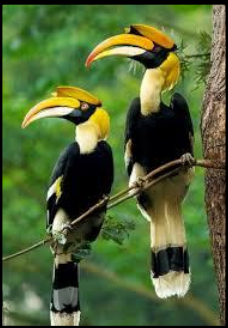
• The Tamil Nadu government has announced the establishment of India’s first Centre of Excellence for Hornbill Conservation at the Anamalai Tiger Reserve (ATR).
About:
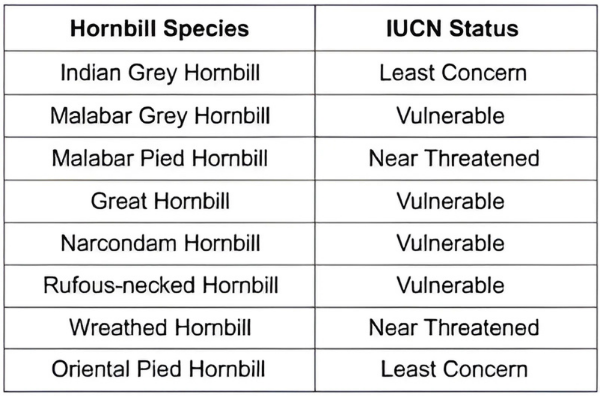
• Focus on conserving four Western Ghats species: Great Hornbill, Malabar Grey Hornbill, Malabar Pied Hornbill, and Indian Grey Hornbill.
• Expansion to include Kalakkad Mundanthurai Tiger Reserve, Sathyamangalam Tiger Reserve, and parts of Kanyakumari.
• Part of Tamil Nadu’s broader conservation strategy after initiatives like Dugong Conservation Reserve, Nilgiri Tahr Project, Slender Loris Conservation Centre, and AI-powered elephant conservation.
About Hornbills
• Large, wide-ranging, fruit-eating birds inhabiting tropical forests with tall trees.
• Notable features: Large curved beaks, booming calls, distinctive wing beats.
• Breeding behaviour: Female seals herself inside a tree cavity; male feeds her through a narrow slit.
• Ecological role: Vital seed dispersers (nicknamed “farmers of the forest”), functioning as keystone species in forest ecosystems.
• India has 9 hornbill species, with 4 in the Western Ghats.
AdFalciVax
Tags :
Context:
• India is developing a Multi-Stage Malaria Vaccine Candidate named AdFalciVax, aimed at protecting against infection and reducing community transmission of Plasmodium falciparum.
About AdFalciVax
• First indigenous recombinant chimeric malaria vaccine targeting two critical stages of Plasmodium falciparum — the deadliest malaria parasite.
• Developed jointly by the Indian Council of Medical Research (ICMR) and the Department of Biotechnology–National Institute of Immunology (DBT–NII).
• Demonstrated excellent efficacy in preclinical trials.
• Designed to both prevent human infection and reduce vector-borne community transmission.
• Aligns with the Make in India initiative for self-reliance in vaccine development.
• ICMR plans to license technology to eligible organizations for further development, manufacturing, and commercialization under non-exclusive agreements.
• Currently in the early R&D phase, not yet available for clinical use or commercial sale.
Financial Inclusion Index (FIIndex) 2025
Tags :
Context:
• The Reserve Bank of India (RBI) announced that the Financial Inclusion Index (FI-Index) for 2025 has improved to 67%, up from 64.2% in FY 2024.
Recent Highlights:
• Usage-led Growth: Rise in digital payments, credit uptake, and insurance penetration.
• Quality Gains: Better service delivery and stronger grievance redressal systems improved the quality score.
About Financial Inclusion Index (FI-Index)
• Aim: Measures the extent of financial inclusion across India.
• The FI-Index measures financial inclusion on a scale of 0 (exclusion) to 100 (full inclusion) and is released annually in July.
• Parameters: Access (35%), Usage (45%), and Quality (20%).
• No designated base year; reflects cumulative efforts over time.
• Developed by the RBI with inputs from multiple stakeholders.
• Other important reports and indices released by RBI include the Financial Stability Report (FSR), Report on Trend and Progress of Banking in India, Monetary Policy Report, and Handbook of Statistics on the Indian Economy.
AI for India 2.0 Programme
Tags :
Context:
• The AI for India 2.0 Programme was launched on 15 July 2023 on World Youth Skills Day.
About AI for India 2.0 Programme
• Provides free online training in Artificial Intelligence (AI) and Machine Learning (ML).
• Focus on vernacular accessibility: content available in nine Indian languages (e.g., Hindi, Telugu, Kannada).
• Target group: College students, fresh graduates, and early-career professionals, especially from rural and non-English-speaking backgrounds.
• Offers expert-curated Python courses to empower youth with tech skills.
• Delivered through a tech platform enabling nationwide accessibility.
• Courses carry nationally accredited recognition.
Pradhan Mantri Surya Ghar Muft Bijli Yojana
Tags :
Context:
• The Union Ministry of New and Renewable Energy (MNRE) informed Parliament that the Pradhan Mantri Surya Ghar Muft Bijli Yojana has benefitted 15.45 lakh households.
About PM Surya Ghar Muft Bijli Yojana
• Launched on 15 February 2024 to provide free electricity to households through rooftop solar panels.
Subsidy Structure:
• 60% of solar unit cost for systems up to 2 kW.
• 40% of additional cost for systems between 2–3 kW.
• Subsidy capped at 3 kW.
• At benchmark prices: ₹30,000 for 1 kW, ₹60,000 for 2 kW, ₹78,000 for 3 kW or higher.
• Special category states: Additional 10% subsidy per kW.
Benefits:
• Target to help 1 crore families get up to 300 units free electricity/month.
• Annual household saving: up to ₹18,000.
• Estimated annual saving for government: ₹75,000 crore.
• Promotes renewable energy use and reduces carbon emissions.
Implementation Timeline & Outlay:
• Outlay: ₹75,021 crore.
• Implementation till FY 2026–27.
Eligibility:
• Indian citizen owning a house with a suitable roof.
• Valid electricity connection.
• Not availed other solar panel subsidies.
Implementation Agencies:
• National Programme Implementation Agency (NPIA) at central level.
• State Implementation Agencies (SIAs) — DISCOMs responsible for net meter provision, inspection, and commissioning.
Kala Utsav 2025
Tags :
Context:
• Artists of Sohrai (Jharkhand), Pattachitra (Odisha), and Patua (West Bengal) participated in the 2nd edition of Kala Utsav 2025 – ‘Artists in Residence Programme’ at Rashtrapati Bhavan.
About:
• First edition (May 2025) featured Madhubani artists from Bihar and Gond artists from Madhya Pradesh.
• Kala Utsav 2025 is an event organized by the Ministry of Education, Government of India, showcasing the artistic talents of secondary school students.
• It’s a platform to foster creativity, cultural diversity, and the spirit of “Ek Bharat, Shreshtha Bharat”.
• The event features various art forms like music, dance, and visual arts. Kala Utsav 2025 also includes an “Artists in Residence Programme” at Rashtrapati Bhavan, where artists from different regions present their work.
Sohrai Painting
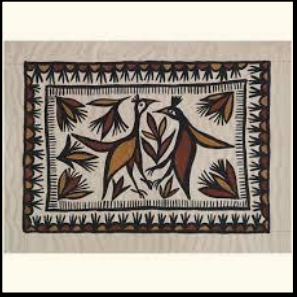
• Tribal mural art painted mainly by women to mark cattle worship and harvest celebrations.
• Practised by indigenous communities in Jharkhand.
• Linked to prehistoric Karanpura Valley cave art (7000–400 BC).
• Associated with the Sohrai harvest festival, celebrated after Diwali.
• Technique: Walls coated with clay; motifs drawn with fingers/sticks using earth pigments.
• Common motifs: Peacocks, bulls, forests, fertility symbols linked to animistic beliefs.
• GI Tag: Sohrai-Khovar painting received GI tag in 2020.
Pattachitra
Tags :
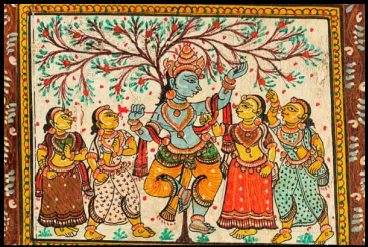
• Traditional cloth-based scroll painting (Patta = cloth, Chitra = picture).
• Practised in Odisha and West Bengal.
• Originated in 5th–12th century CE, associated with Jagannath worship in Puri.
• Known for bold lines, intricate mythological details, and lacquered finish.
• GI Tag: Odisha Pattachitra (2008), Bengal Patachitra (2018).
Patua Art
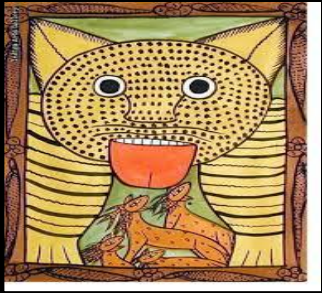
• Traditional scroll painting performed with Patua Sangeet (songs) as scrolls are unrolled.
• Practised in West Bengal, Bihar, Jharkhand, Odisha, and parts of Bangladesh.
• Evolved from Mangal Kavya traditions post-13th century CE.
Exercise Bold Kurukshetra 2025
Tags :
Context:
• The 14th edition of Exercise Bold Kurukshetra 2025 commenced between the Indian Army and Singapore Army, focusing on joint operational procedures in mechanised warfare.
About:
• Location: Jodhpur Military Station, Rajasthan.
• Format: Tabletop exercise and computer-simulated wargame.
• Aim: Test interoperability and coordination in mechanised warfare scenarios.
• Significance:
o Strengthens India–Singapore defence cooperation.
o Enhances regional security collaboration in the Indo-Pacific.
UN’s State of Food Security and Nutrition in the World (SOFI) Report 2025
Tags :
Context:
• The UN’s State of Food Security and Nutrition in the World (SOFI) 2025 report highlights that India continues to face high levels of child wasting, stunting, and anaemia, despite a decline in undernourishment rates.
About SOFI Report
• Flagship UN publication jointly released by FAO, IFAD, UNICEF, WFP, and WHO.
• Tracks progress towards SDG 2: Zero Hunger.
• Key Indicators: Wasting, stunting, anaemia, hunger, and food insecurity.
• Data based on national surveys and UN nutrition databases.
Key Findings – India
• Wasting: Highest global rate at 18.7%, affecting 21 million children.
• Stunting: 37.4 million stunted children under five.
• Anaemia: 53.7% of women aged 15–49 (203 million) are anaemic.
• Undernourishment: 172 million undernourished (down from 243 million).
Key Terms
• Stunting: Low height-for-age in children, indicating chronic undernutrition.
• Wasting: Low weight-for-height in children, reflecting acute undernutrition.
• Anaemia: Condition marked by low haemoglobin levels, reducing the blood’s oxygen-carrying capacity.
Great Indian Bustard
Tags :
Context:
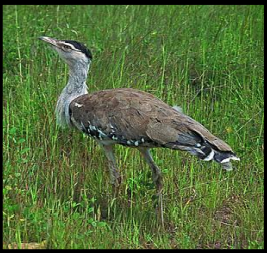
• A Supreme Court-appointed expert committee has recommended designated power corridors for transmission lines in Great Indian Bustard (GIB) habitats in Gujarat and Rajasthan to reduce bird collision fatalities.
About Great Indian Bustard (GIB)
• Scientific name: Ardeotis nigriceps.
• One of the heaviest flying birds, found mainly in Rajasthan and Gujarat, with small populations in Maharashtra, Karnataka, and Andhra Pradesh.
• Habitat: Arid and semi-arid grasslands and scrublands.
• IUCN Status: Critically Endangered.
• Wildlife Protection Act, 1972: Schedule I species.
• CITES: Appendix I.
• Population: Fewer than 150 individuals left in the wild, mostly in Rajasthan’s Desert National Park.
• Threats: Habitat loss, hunting, and collisions with power transmission lines.
• Conservation Efforts: Project Great Indian Bustard, captive breeding programmes, Supreme Court orders to underground power lines in core habitats.
Police Network (POLNET)
Tags :
Context:
• India is upgrading the Police Network (POLNET), a secure satellite-based communication system for police and security forces, especially in remote and border areas.
About POLNET
• Launch: Introduced in 2002; nationwide commissioning in 2006.
• Developed by: Directorate of Coordination Police Wireless (DCPW), Ministry of Home Affairs.
• Purpose: Provides real-time, secure communication to police forces across India.
Organic Certification in India
Tags :
Context:
• APEDA has refuted allegations regarding Organic Cotton Certifications in India.
About Organic Certification in India
• National Programme for Organic Production (NPOP):
o Implemented by APEDA, Ministry of Commerce & Industry.
o Covers accreditation of certification bodies, setting standards for organic production, promoting organic farming, and marketing.
o NPOP standards for production and accreditation are recognised by the European Commission and Switzerland for unprocessed plant products as equivalent to their own standards.
• Participatory Guarantee System (PGS-India) Certification:
o Community-based certification where producers inspect, verify, and certify each other’s farms as organic.
o Certification applies to the entire holding of the group, not just part of it.
Geelong Treaty
Tags :
Context:
• Australia and the United Kingdom (UK) have signed the Geelong Treaty – a bilateral Nuclear-Powered Submarine Partnership and Collaboration Treaty under AUKUS Pillar I.
About Geelong Treaty
• Establishes the legal framework for designing, building, operating, and maintaining nuclear-powered submarines under the AUKUS security pact.
• Part of AUKUS Pillar I, which focuses on providing Australia with conventionally armed, nuclear-powered submarines.
• Facilitates technology transfer, workforce training, and integration of UK and Australian defence industries.
• Enhances interoperability between Royal Australian Navy and Royal Navy.
• Supports Indo-Pacific security by boosting undersea warfare capabilities and deterring regional threats.
Global Specs 2030 Initiative
Tags :
Context:
• The World Health Organization (WHO) has launched the Global Specs 2030 initiative.
About Global Specs 2030 Initiative
• Seeks to achieve universal access to affordable, quality, and safe eyeglasses by 2030.
• Addresses the global burden of uncorrected refractive errors, a major cause of vision impairment and preventable blindness.
• Promotes affordable manufacturing, distribution, and quality standards for spectacles.
• Integrates vision screening into primary healthcare systems.
• Strengthens local supply chains to reach underserved communities.
• Targets children, elderly, and populations in low- and middle-income countries with limited access to corrective eyewear.
• Implemented by WHO in collaboration with global partners, NGOs, and private sector stakeholders.
NASA’s TRACER Mission
Tags :
Context:
• NASA has launched its twin TRACERS satellites to study magnetic reconnection and how solar activity impacts the near-Earth atmosphere.
About TRACERS Mission
• Stands for Tandem Reconnection and Cusp Electrodynamics Reconnaissance Satellites.
• Aims to understand magnetic reconnection and its influence on Earth’s atmosphere.
• Operates in low Earth orbit, passing through polar cusps — funnel-shaped openings in Earth’s magnetic field.
• Studies how solar wind and charged particles from the Sun interact with Earth’s magnetosphere.
• Expected to record data from over 3,000 reconnection events in its first year.
• Data will help improve space weather forecasting and protect satellites, astronauts, and GPS systems.
About Magnetic Reconnection
• Occurs when solar wind collides with Earth’s magnetic field, causing field lines to snap and release massive energy.
• Can accelerate particles to high speeds, creating auroras but also disrupting satellites, communication, and navigation systems.
• Polar cusp regions allow a direct pathway for solar wind into Earth’s atmosphere, making them ideal for study.
Schengen Visa
Tags :
Context:
• The European Commission has introduced a new “cascade” system for Schengen visas, enabling Indian travellers with a clean visa history to obtain fast-tracked, long-term multiple-entry visas.
About Schengen Visa
• A Schengen visa allows non-EU nationals to temporarily visit or transit through the Schengen Area, comprising 29 European countries with no internal border checks.
• Valid for up to 90 days within a 180-day period from the date of first entry.
• Issued for purposes such as tourism, business, family visits, medical treatment, and cultural/sporting events.
• Does not grant the right to work.
• Schengen members include 25 EU states (excluding Cyprus and Ireland) and 4 EFTA states (Iceland, Liechtenstein, Norway, Switzerland).
• The history of Global Tiger Day dates back to 2010. During a summit held in St. Petersburg, the governments from tiger range countries came together and decided to double the wild tiger population by 2022.