
July 3'rd Week
Print PDF
General Studies I
Indian Society- Protecting India’s Linguistic Secularism
Tags :
News Context
• Recent linguistic unrest in Maharashtra has brought India’s commitment to linguistic secularism and constitutional unity into sharp focus.
Linguistic Diversity Landscape of India
• According to the 2011 Census, India has 121 languages and 270 mother tongues.
• Around 96.71% of the population speaks one of the 22 scheduled languages as their mother tongue.
• The Eighth Schedule of the Constitution currently lists 22 languages, granting them official recognition.
• The remaining 99 languages are classified as non-scheduled languages, lacking formal constitutional status.
• This classification reflects both India’s vast linguistic diversity and the need for inclusive language policy.
Constitutional Safeguards for Linguistic Secularism in India
• Unlike Western secularism, which emphasizes strict separation between religion and state, Indian secularism is inclusive, embracing both religious and linguistic plurality.
• The Indian Constitution provides several safeguards to uphold linguistic diversity and unity:
Article 343: Declares Hindi in Devanagari script as the official language of the Union; permits States to adopt their own official languages, recognizing regional linguistic identities.
Article 29: Ensures that minority communities have the right to conserve their distinct language, script, and culture.
Eighth Schedule of the Constitution: Lists 22 scheduled languages, reflecting the Constitution’s commitment to protect and promote linguistic diversity.
Contemporary Challenges to Linguistic Harmony in India
Identity Politics and Linguistic Violence: Attacks on non-Marathi speakers in Maharashtra highlight politicization of linguistic identity under the guise of cultural preservation. Similar tensions have emerged in Assam over Assamese primacy in official communication.
Fears of Language Imposition: Resistance to Hindi promotion in non-Hindi states (Tamil Nadu, Karnataka, Northeast) due to fears of diluting local languages. Opposition intensified during NEP language debates.
Marginalization of Smaller Languages: Several tribal/minority languages (e.g., Gondi, Bodo) face declining speakers due to dominance of regional majority languages; lack of institutional support accelerates erosion.
Language Purism Movements Turning Intolerant: Campaigns like Meitei linguistic purism in Manipur (removing loanwords) create cultural gatekeeping and suppress natural evolution.
Undermining Federal Pluralism: Political use of language identity to exclude or intimidate erodes trust in India’s multilingual framework, reducing cooperative coexistence.
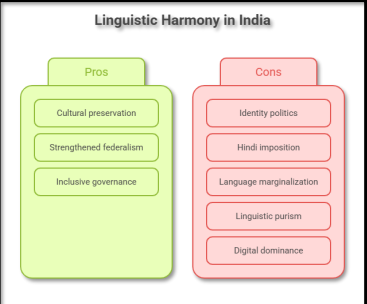
Digital and Market Dominance of Certain Languages: English and Hindi dominate digital platforms, media, and e-governance, sidelining regional languages and limiting access to schemes/education.
Inadequate Mother-Tongue Education Implementation: Despite NEP 2020, states lack material and trained teachers for local-language education.
Way Forward for Strengthening Linguistic Harmony
Constitutional Safeguards in Action: Implement Articles 29 & 30 protections; strengthen Commissioner for Linguistic Minorities.
Political Accountability: Leaders must avoid divisive rhetoric and instead promote inclusive narratives.
Promotion of Multilingualism: Encourage multilingual education via flexible three-language formula; increase regional language media content.
Support for Non-Scheduled Languages: Provide policy/financial support, digitize endangered languages, integrate into school curricula.
Policy Safeguards for Equity: Ensure equitable use of multiple languages in administration, education, e-governance; mandate bilingual/multilingual signage.
Civic Engagement & Public Awareness: Promote linguistic respect via festivals, classroom activities, exchanges; encourage citizens to learn/use multiple Indian languages.
Institutional Oversight: Regularly review language policy compliance; use technology for real-time service availability in regional languages.
Conclusion
Justice V.R. Krishna Iyer’s words, “I am all for Hindi as a personal preference, but I am all against Hindi by compulsion. Linguistic militancy will alienate and divide, but federal pluralism is democratic sensitivity,” capture India’s linguistic ethos. The country’s strength lies in embracing multiple languages, faiths, ideas, and ways of life. Retreating into linguistic or cultural insularity risks fragmentation and erosion of the secular fabric. Upholding harmony through voluntary acceptance, not coercion, is a constitutional responsibility and democratic necessity for India’s unity in diversity.
Question for Practice
• In a multilingual society like India, linguistic harmony is essential for social cohesion and national integration. In this context, critically analyse the concept of ‘linguistic secularism’ and the challenges it faces in contemporary India. (10 Marks, 150 Words)

General Studies II
Resignation of Vice-President
Tags :
News Context
• The 14th Vice-President of India Mr. Jagdeep Dhankhar leaves office with two years left in his term; decision comes on the first day of Monsoon Session of Parliament; stepping down to abide by medical advice.
About Vice-President of India
• The Vice President is the second-highest constitutional office in India and serves as the ex-officio Chairman of the Rajya Sabha (the Upper House of Parliament).
• The Vice President takes over as Acting President if the President dies, resigns, is removed, or is incapacitated up to six months or until a new President is elected.
• Lifetime term is five years, with eligibility for re-election, though the incumbent continues until a successor assumes office.
• Election is conducted indirectly by an electoral college of members of both houses of Parliament via proportional representation with a single transferable vote and secret ballot.
• The Vice President also holds chancellorships and other ceremonial roles at certain universities and institutions.
Constitutional Provisions for the Vice President of India
• Article 63 – The Vice-President of India. “There shall be a Vice-President of India.”
• Article 64 – The Vice-President to be ex officio Chairman of the Council of States (Rajya Sabha).
• Article 66 – Election of Vice-President.
• Article 67 – Term of Office and Removal.
• Article 68 – Time of Holding Election to Fill Vacancy.
Election and Eligibility
Electoral College: Members of both Houses of Parliament (Lok Sabha and Rajya Sabha). Includes nominated members (different from the Presidential election).
Voting Method: Proportional Representation System by means of a Single Transferable Vote (STV); voting by secret ballot.
How it works:
Each MP ranks the candidates in order of preference.
To win, a candidate must get more than 50% of the valid votes.
If no one gets this in the first round, the candidate with the least votes is eliminated, and second preferences are counted — this continues until a winner is found.
Conduct of Election:
The election is conducted by the Election Commission of India.
The schedule is usually announced a few weeks before the Vice President’s term ends or when there’s a vacancy.
All rules, ballot papers, counting, and results are handled under the guidance of the Election Commission.
Eligibility (Article 66):
a. Citizen of India
b. At least 35 years old
c. Qualified to be elected as a member of the Rajya Sabha
d. Must meet the same qualifications as required for Rajya Sabha membership
e. Not hold any office of profit
f. Should not be holding a salaried government job or post, unless permitted by the Constitution.
Role of Vice-President
Constitutional Role and Functions:
A] Ex-officio Chairman of the Rajya SabhaPresides over the proceedings, ensuring discipline, impartiality, and adherence to rules.
Can cast a deciding vote in case of a tie.
Though not a member, plays a key role in shaping legislative debates.
B] Acting as PresidentIn case of vacancy, resignation, removal or death of the President, assumes the role of Acting President.
Performs all functions of the President for a maximum period of 6 months until a new President is elected.
C] Symbol of Continuity and StabilityServes as a constitutional backup, ensuring no vacuum in executive leadership.
Enhances resilience of the Indian political system.
Criticism
• Largely ceremonial role with limited powers.
• Does not participate in cabinet meetings, policymaking, or administration.
• Elected only by MPs, lacks a wider democratic mandate unlike the President.
• Expected neutrality as Rajya Sabha Chairperson often questioned due to political backgrounds.
• Acts as President only temporarily; cannot complete the President’s term.
• Debate over cost vs utility of maintaining a separate office with staff and residence.
Scholarly & Committee Observations
• H.M. Seervai: Role constitutionally valid but functionally weak.
• Second ARC: Did not recommend scrapping office, but suggested improved neutrality and efficiency in Rajya Sabha functioning.
• Dr. B.R. Ambedkar: “The Vice-President occupies a position analogous to that of the Vice-President of the United States. His normal function is to preside over the Council of States.”
Conclusion
The Vice President holds a vital and multifaceted role, serving as both a key executive leader and a constitutional officer. While often seen as largely ceremonial, the Vice President ensures continuity of leadership, presides over the Rajya Sabha, and represents stability in the Indian political system.
Mains Question for Practice
“The office of the Vice President of India is a unique blend of legislative and constitutional responsibility, yet it remains largely ceremonial in political practice.” Evaluate (10 Marks, 150 words).
Women in the STEM Sector
Tags :
Context (TH)
• Women in India continue to face enduring challenges that limit their access to careers in Science, Technology, Engineering, and Mathematics (STEM).
The STEM Paradox in India
• Women constitute 43% of STEM graduates in India—one of the highest globally—but only 27% of the STEM workforce.
• PLFS 2023–24: Female Labour Force Participation Rate (FLFPR) = 41.7% (Rural: 47.6%, Urban: 25.4%). Despite rising, STEM careers still show a wide gender gap.
• India faces a “leaky pipeline” problem: women leave STEM jobs mid-way due to unfriendly work environments, social expectations, caregiving burdens.
Need for Gender Inclusion in STEM
• Economic Growth: $700 billion GDP boost possible (McKinsey). A 50% female workforce can raise GDP growth by 1% (World Bank).
• Innovation & Problem-Solving: Gender-diverse teams are more creative and effective.
• Social Justice: Women in STEM break stereotypes, inspire future generations.
• Bridging Talent Gap: Helps overcome global tech and research shortages.
• Better Governance & Research: Gender-balanced teams address healthcare, AI, climate, etc., more inclusively.
• Global Commitments: Supports SDG 5 (Gender Equality), SDG 4 (Quality Education), SDG 8 (Decent Work).
• Ethical Work Culture: More women → safer, inclusive workplaces.
• Demographic Dividend: India cannot afford to underuse half of its workforce.
Challenges for Women in STEM
• Gender Stereotypes: Perception that STEM is “male-dominated”.
• Workplace Barriers: Lack of flexible policies, safety, maternity support, work-life balance.
• Limited Awareness: Rural girls lack access to STEM role models and exposure.
• Skill–Employment Gap: Poor industry-academia linkages and outdated curricula.
• Lack of Mentorship: Few women in senior roles → limited networking.
• Unconscious Bias: Hiring and promotions often undervalue women.
• Attrition in Mid-Career: Caregiving duties, lack of re-entry support cause dropouts.
Government Initiatives
• NEP 2020: STEM promotion, experiential learning, gender inclusion.
• Gender Budgeting: Raised to 8.8% in 2025–26 Budget (₹4.49 lakh crore).
• Beti Bachao, Beti Padhao: Encourages girls’ higher education, including STEM.
• Skill India Mission: Trains women in IT, electronics, mechanical fields.
• Digital India: Expands digital literacy and tech entrepreneurship for women.
• STEM Scholarships: Vigyan Jyoti, KIRAN schemes support women scientists.
Way Forward
• Industry–Academia Linkages: More internships, industry projects, updated curricula.
• Gender-Sensitive Workplaces: Safety, flexible work, maternity/childcare support.
• Mentorship & Role Models: Senior women leaders guiding young professionals.
• Early Exposure: Rural STEM campaigns, coding/robotics in schools.
• Re-skilling & Re-entry: Targeted programs for women restarting careers.
• Policy Interventions: Gender budgeting in R&D, diversity targets in STEM initiatives.
Conclusion
• Bridging the STEM gender gap is a necessity for inclusive growth, not just equity.
• As John Stuart Mill said: “The emancipation of women…is one of the chief means of human improvement.”
• Nehru: “You can tell the condition of a nation by looking at the status of its women.”
• Gender inclusion in STEM is a moral, social, and economic imperative for India’s sustainable future.
Question for Practice
• Despite having one of the highest shares of women STEM graduates globally, India continues to witness low female participation in the STEM workforce. Examine the reasons for this paradox and suggest a roadmap to improve gender inclusion in the STEM sector. (250 words)
General Studies III
Fifth Generation Fighter Jet
Tags :
News Context
In a significant push towards enhancing India’s indigenous defence capabilities and fostering a robust domestic aerospace industrial ecosystem, Defence Minister Rajnath Singh has approved the Advanced Medium Combat Aircraft (AMCA) Programme Execution Model. The Aeronautical Development Agency (ADA) will execute the programme through industry partnership.
What is a Fifth-Generation Fighter Jet?
Definition: Most advanced fighter aircraft with stealth, agility, situational awareness, and networked warfare capabilities.
Evolution: Significant leap from earlier generations in terms of air superiority and multirole capability.
Key Features of 5th Generation Fighter Jets
Stealth Technology: Radar cross-section reduction, internal weapons bay, radar-absorbent materials.
Super Cruise: Ability to fly at supersonic speeds without afterburners (fuel efficient, longer combat endurance).
Advanced Avionics & Sensor Fusion: Real-time integration of radar, infrared, electronic warfare systems; 360° situational awareness.
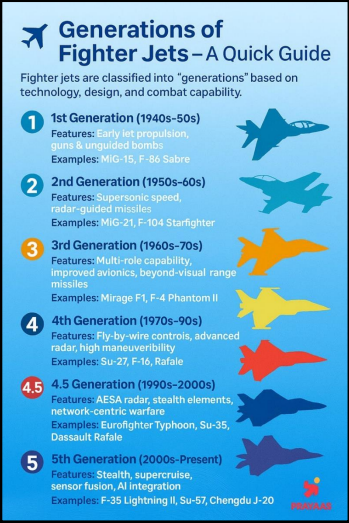
Network-Centric Warfare: Integration with satellites, drones, ground & naval systems for coordinated operations.
Highly Agile Airframe: High thrust-to-weight ratio & advanced flight control systems.
Multirole Capability: Air-to-air, air-to-ground, electronic warfare, reconnaissance.
Advanced Medium Combat Aircraft (AMCA)
Overview: India’s indigenous 5th-gen twin-engine stealth multirole combat aircraft, developed by ADA-DRDO for the IAF and future Navy use. Intended to replace Sukhoi Su-30MKI, MiG-29, Mirage 2000.
Timeline: In March 2024, CCS approved prototype development with ~₹15,000 crore funding for five prototypes. First flight expected 2028–29; induction post-2035.
Key Features
Stealth: Diverterless supersonic inlets, “S-shaped” air intakes, internal weapon bays, radar-absorbent composites (38–40%), IIT Kanpur’s Anālakṣhya cloaking tech.
Performance: MTOW ~25 tonnes, Mach 2.15, combat range ~1,600 km, internal fuel capacity ~6,500 kg.
Avionics: AESA “Uttam” radar, AI-based electronic pilot, sensor fusion, net-centric warfare capabilities.
Roles: Air supremacy, SEAD, ground strike, electronic warfare.
Significance of Fifth-Generation Fighter Jets
Stealth Dominance: Enables deep penetration without detection (e.g., F-22, F-35).
Network-Centric Force Multiplication: Acts as airborne command nodes.
Survivability & Lethality: Super-cruise, stealth, internal weapons ensure survivability & precision strike.
Strategic Deterrence: Symbol of tech prowess & deterrence.
Technological Sovereignty: Boosts defence indigenization & reduces import dependency.
Operational Flexibility: Multi-role capability in one sortie.
Challenges
Technological Complexity: Stealth design (radar-absorbing materials, IR signature control) is difficult.
Engine Development Bottleneck: Lack of indigenous 110 kN-class jet engine.
High Costs: Development & maintenance extremely expensive (~₹15,000 crore+).
Weak Industrial Ecosystem: Limited aerospace supply chains & private sector integration.
Delayed Timelines: R&D & bureaucratic delays may push induction post-2035, when 6th-gen jets may be operational elsewhere.
Conclusion
The AMCA programme is not just a technological milestone but a strategic necessity for India. As PM Modi emphasized at Aero India 2023, the goal is to make India a hub of defence manufacturing—reducing imports and becoming an exporter of modern defence platforms.
Mains question for practice:
“Indigenous development of fifth-generation fighter aircraft is no longer a strategic choice, but a necessity for India.” Discuss in the context of the AMCA programme and evolving regional security dynamics. (15 Marks, 250 words)
India’s Defence Exports
Tags :
News Context
• In the wake of Operation Sindoor, global interest in India’s advanced defence platforms — from hypersonic missiles and stealth fighters to laser-based weapons witnessed a significant surge.
Trends and Milestones in India’s Defence Export Growth
• Record Expansion: Exports surged from ₹686 crore in 2013–14 to ₹23,622 crore in 2024–25.
• Rising Private Sector Role: Private firms contributed ₹15,233 crore, accounting for ~65% of total exports.
• PSU Performance Boost: Defence PSUs recorded 42.85% growth, aided by streamlined export approval processes.
• Diverse Global Markets: Exports reached ~80 countries, with major buyers including the USA, France, and Armenia.
• Broad Product Portfolio: Exported platforms ranged from BrahMos and Akash missiles to UAVs, artillery systems, radars, and Dornier aircraft.
Operation Sindoor as a Catalyst for India’s Defence Export Growth
• Combat-Proven Credibility: Weapons like BrahMos missiles, Akash SAMs, swarm drones, and Akashteer air-defence systems were used successfully in real combat, boosting global buyer trust.
• Market Confidence: Defence stocks gained ~21% during operation week, reflecting strong investor faith in India’s defence industry.
• Technological Showcase: Akashteer achieved 100% interception success; BrahMos precision strikes drew interest from countries like the Philippines and Indonesia.
• Comparative Advantage: Indian systems outperformed Chinese-origin weapons in Pakistani use, strengthening India’s competitive image in defence markets.
• Policy Acceleration: Government reduced procurement timelines from 6 to 2 years and advanced plans for ammunition self-reliance by end-2025.
• Private Sector Boost: States like Tamil Nadu and Uttar Pradesh reported 5× rise in defence equipment export inquiries post-operation.
• Global Outreach: India conducted diplomatic briefings in ~70 nations showcasing Sindoor-deployed systems, increasing market penetration.
Indigenous Weapons and Systems Used in Operation Sindoor
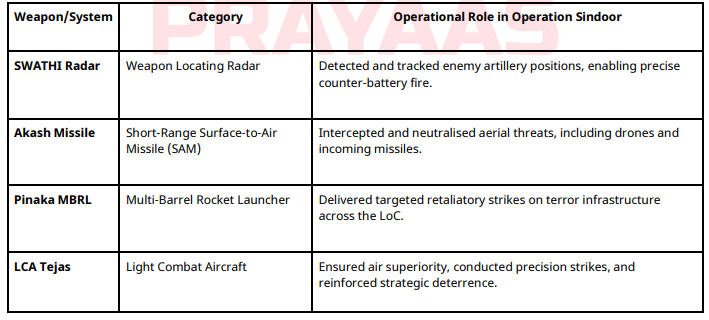
Key Factors Fuelling India’s Defence Export Rise
• Opening the Market to Private Players: Relaxed policies have allowed private companies to enter and expand in the export space, adding agility and innovation to production.
• Simplified Clearances: Digital approvals, removal of certain licensing requirements, and faster processing have made the export process smoother and more predictable.
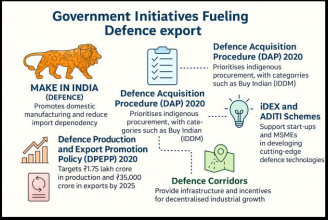
• Price Advantage: India’s ability to manufacture at lower costs and in large volumes has made its defence products competitive in global tenders.
• Diplomatic Leverage: Direct government-to-government arrangements have strengthened trust and facilitated large-scale deals.
• Financing Edge: Affordable credit lines from EXIM Bank have reduced the financial burden on importing nations.
• Rising Global Demand: Defence budget hikes after the Ukraine conflict have pushed many countries to seek dependable, cost-effective alternatives to Western arms.
• Boost from Indigenisation: With three-fourths of the capital defence budget going to domestic procurement, India’s production ecosystem has become more robust and export-ready.
Hurdles in India’s Defence Export Expansion
• Humanitarian Compliance Deficit: Absence of a mandatory legal or ethical review mechanism to assess potential buyers’ human rights track record and conflict involvement creates reputational risks.
• Technology Gaps: Continued reliance on imported engines, advanced sensors, propulsion systems, and electronics limits the ability to export fully indigenous, high-end platforms.
• Intense Global Competition: Established exporters such as the US, Russia, France, and China maintain strong market dominance, backed by entrenched alliances and long-term contracts.
• Regulatory Bottlenecks: Multi-layered procurement and export authorisation processes often slow decision-making, reducing industry responsiveness to emerging opportunities.
• Industrial Weaknesses: Fragmented supply chains, inadequate maintenance/after-sales infrastructure, and slow-moving PSUs reduce global competitiveness.
• Geopolitical Sensitivities: Arms sales to politically volatile or diplomatically sensitive regions risk diplomatic backlash or straining strategic partnerships.
• Limited Marketing Presence: Inadequate participation in global defence expos and absence of aggressive brand positioning hinder visibility in competitive markets.
• R&D Underinvestment: Relatively low investment in cutting-edge areas such as AI-enabled combat systems, next-gen propulsion, and autonomous platforms affects technological leadership.
• Export Financing Limitations: While EXIM Bank support exists, the scale and coverage of financing remain insufficient compared to international competitors offering extensive credit and insurance packages.
Way Forward
• Deepen Technology Self-Reliance: Accelerate indigenous development of propulsion systems, sensors, avionics, and electronics through targeted R&D funding and strategic industry–academia partnerships.
• Strengthen Global Market Presence: Increase participation in international defence exhibitions, appoint defence attachés with export promotion mandates, and set up dedicated marketing arms for major product lines.
• Streamline Regulatory Processes: Introduce a single-window clearance mechanism for defence exports, with defined timelines to improve responsiveness to foreign procurement cycles.
• Build Industrial Depth: Develop robust tier-2 and tier-3 supplier networks, incentivise private–public partnerships in after-sales servicing, and modernise PSU production units for efficiency.
• Expand Export Financing: Scale up EXIM Bank credit lines and explore sovereign-backed export insurance to match competitor nations’ financial packages.
• Focus on High-Demand Segments: Prioritise competitive, high-demand categories such as UAVs, missile systems, electronic warfare, and coastal defence platforms for targeted marketing.
• Forge Strategic Export Alliances: Pursue co-development and joint production agreements with friendly nations to secure long-term market access.
• Leverage Geopolitical Opportunities: Align export strategies with India’s Indo-Pacific and Global South outreach to consolidate new markets amid shifting global defence procurement patterns.
Conclusion
• As PM Modi aptly stated, “India will not just be a market for defence products, but a maker of defence power.” This is no longer a distant aspiration but a demonstrated reality with indigenous systems proving their mettle in operations like Sindoor and gaining traction in global markets. Sustained policy support, technological innovation, and strategic diplomacy can ensure that India’s rise as a defence exporter is both irreversible and globally influential.
Question for Practice:
• India’s recent surge in defence exports reflects both strategic intent and industrial transformation. Discuss the factors driving this growth, the challenges that remain, and the measures needed to sustain India’s position as a competitive global defence exporter. (15 Marks, 250 Words)