
July 4'th Week
Print PDF
General Studies I
Polyandry in Scheduled Tribes in India
Tags :
News context:
• A tribal woman from the Hatti community in Himachal Pradesh married two brothers under a traditional system of Polyandry.
• Jodidaran is a fraternal polyandry practised by the Hatti tribe, where a woman marries multiple brothers to prevent land division, strengthen bonds, and ensure social security within joint families.
About Hatti Tribe:
• Location: Indigenous to the Trans-Giri region (Himachal Pradesh) and Jaunsar Bawar region (Uttarakhand).
• Rivers: Settled around the Giri and Tons rivers, tributaries of the Yamuna.
• Etymology: “Hatti” derives from “haat” (traditional village markets).
• Population: Around 2.5 lakh in 2011; now estimated at 3 lakhs.
• Traditional Governance: Khumbli (tribal council) handles disputes and key decisions.
• Social Structure: Divided into upper castes (Bhat, Khash) and lower castes (Badhois).
• Livelihood: Depend mainly on agriculture; eco-tourism also provides seasonal income.
• Backwardness: Social and educational deprivation due to geographical isolation.
Scheduled Tribe Status:
• Jaunsar Bawar (Uttarakhand) recognized in 1967.
• Trans-Giri region (Himachal Pradesh) granted status in 2023–24.
Legal Status of Polygamy and Polyandry:
• Prohibition: Banned under Hindu Marriage Act (1955), Special Marriage Act, and Bharatiya Nyaya Sanhita.
• Exemption for Scheduled Tribes: These laws do not automatically apply to Scheduled Tribes unless notified by the Central Government.
• Constitutional Provision: Article 342 gives Scheduled Tribes distinct legal recognition.
• Legal Exemption Clause: Section 2(2) of the Hindu Marriage Act exempts Scheduled Tribes unless otherwise notified.
• Definition of Custom: Recognised if the practice is long-standing, reasonable, and not against public policy.
• Judicial Requirement: Courts need clear evidence to validate customary laws.
• Uniform Civil Code (Uttarakhand, 2024): Explicitly excludes Scheduled Tribes.
• UCC Rules (2025): Confirms UCC does not apply to groups protected under Part XXI of the Constitution.
Judicial and Constitutional Scrutiny:
• The judiciary affirms that personal customs cannot override fundamental rights (Articles 14, 15, and 21) or deprive others of constitutional rights.
Key Supreme Court Precedents:
• Triple Talaq Case: SC struck down instant divorce as arbitrary and violative of equality rights.
• Sabarimala Entry Case: SC held the exclusion of women unconstitutional under Articles 14 and 15.
• Ram Charan Case (2024): SC upheld tribal women’s inheritance rights in the absence of a valid opposing custom.
Legal and Ethical Challenges of Tribal Polyandry:
• Gender Autonomy: Polyandrous arrangements often deprive women of enforceable rights (e.g., 2024 Sunita Chauhan case).
• Oral Traditions: The absence of documented Hatti customs limits judicial recognition and access to legal remedies.
• Custom vs. Justice: Certain customs may perpetuate regressive norms under the guise of cultural legitimacy.
• Limited Representation: Tribal women often have minimal participation in Khumbli council decisions.
• Judicial Constraints: Courts face difficulties in validating customs without written evidence or broad community agreement.
• Resistance to Reform: Imposed reforms from outside the community may face rejection unless supported by local engagement and awareness.
• Human Rights Concerns: Polyandry may conflict with constitutional guarantees of equality, dignity, and personal liberty.
• Inheritance and Property Disputes: Lack of clear legal frameworks creates disputes over lineage, custody, and property rights.
• Social Stigma and Marginalisation: Women challenging such customs may face ostracism within their community.
Way Forward:
• Opt-In UCC Models: The example of Goa’s Uniform Civil Code demonstrates that integration can be achieved while respecting recognised community traditions.
• Tribal-Led Reform: Experiences from Nagaland’s village-level reforms highlight the effectiveness of change driven by internal community participation.
• Women’s Rights Awareness: Platforms such as the Ministry of Tribal Affairs’ Van Dhan Kendras can be leveraged to promote legal and rights literacy among tribal women.
• Culturally Sensitive Reform: The Xaxa Committee (2014) emphasised pursuing reforms that uphold both cultural identity and the principles of equity.
Conclusion:
• While tribal polyandry in regions like the Hatti community is rooted in historical socio-economic compulsions such as land preservation and resource sharing, in contemporary India it raises serious concerns over gender equality, individual rights, and access to justice.
• As sociologist André Béteille cautions, “Customs must evolve to preserve culture without perpetuating inequality.”
• The challenge lies in balancing constitutional guarantees of dignity and autonomy (Articles 14, 15, and 21) with respect for cultural diversity under Article 29, ensuring that tradition and rights coexist without one undermining the other.
Mains Question for Practice:
• “In certain tribal communities, customs like polyandry are defended as cultural practices but raise serious questions on gender rights and constitutional morality”. Discuss the legal, ethical, and socio-cultural challenges of regulating such practices. (10 Marks, 150 words)
General Studies II
India-Nepal Relations
Tags :
Context:
• Recently, India signed an agreement with Nepal to implement 5 high-impact community development projects (HICDPs) in education and health sectors under an Indian grant of ₹390 million.
High-Impact Community Development Projects:

Introduction:
• India is Nepal’s largest trade partner and top source of FDI, with bilateral trade exceeding $7 billion.
• Guided by the age-old ‘Roti-Beti ka Rishta’, the open border fosters deep people-to-people ties, shared festivals, and seamless pilgrimage and tourism.
Historical Background:
• The 1950 Treaty of Peace and Friendship forms the foundation of India–Nepal relations, enabling free movement of people, residence, trade, and mutual security cooperation.
• India and Nepal share deep-rooted civilizational ties based on religion, culture, language, and kinship, especially in border regions.
Strategic Significance of Projects:
• Social Sector Strengthening: Improves access to healthcare and education in Nepal’s underserved regions, supporting decentralisation and inclusive development.
• Instrument of Soft Power: Grassroots projects enhance India’s image as a benevolent partner, fostering cultural affinity and people-to-people bonds.
• Trust and Stability Builder: Reflects India’s proactive “Big Brother” approach, generating goodwill and promoting regional stability.
• Countering External Influence: Strengthens India’s developmental footprint in Nepal, reducing space for competing strategic actors such as China.
• Disaster Resilience and Preparedness: Joint projects can build community capacity for disaster management in a seismically and climatically vulnerable region.
• Economic Integration Catalyst: Enhances cross-border connectivity and economic interdependence through infrastructure and livelihood support.
• Diplomatic Signalling: Underscores India’s commitment to the Neighbourhood First Policy, reinforcing bilateral trust at both political and societal levels.
Key Challenges in India–Nepal Bilateral Relations:
• Border Disputes: Persistent differences over Susta, Kalapani, and the Lipulekh tri-junction continue to strain trust.
• Implementation Delays: Long-standing agreements such as the Kosi (1954) and Mahakali (1996) treaties remain stalled, with projects like the Pancheshwar Multipurpose Project pending.
• Security Vulnerabilities: The porous and open border facilitates illegal migration, smuggling, human trafficking, and potential infiltration.
• Treaty Frictions: Nepal perceives the 1950 India–Nepal Friendship Treaty as outdated and unequal, seeking revision.
• China’s Strategic Footprint: Beijing’s infrastructure investments and chequebook diplomacy challenge India’s influence in Nepal.
• Political Instability in Nepal: Frequent changes in government disrupt continuity in bilateral engagement and project execution.
• Perception Gap: Media narratives and political rhetoric in both countries sometimes fuel mistrust, affecting public opinion.
Way Forward:
• Fast-track Project Implementation: Prioritise timely completion of flagship initiatives like the Pancheshwar Multipurpose Project and cross-border connectivity corridors to rebuild trust and demonstrate delivery.
• Political and Diplomatic Outreach: Employ quiet diplomacy to address sensitive internal issues such as Madhesi representation, fostering bilateral consensus without public confrontation.
• Soft Power Expansion: Strengthen cultural, religious, and educational exchanges; enhance digital connectivity through UPI–RuPay integration; and promote tourism cooperation (e.g., Buddhist and Ramayana circuits).
• Strategic Balancing: Offer transparent, sustainable, and locally beneficial alternatives to counterbalance China’s growing strategic and economic presence.
• Joint Security Mechanisms: Enhance cooperation on border management, anti-trafficking, and disaster preparedness to build mutual confidence.
• Institutionalised Dialogue: Create regular high-level review mechanisms to ensure continuity despite political changes in Nepal.
Conclusion:
• India–Nepal relations are bound by geography, culture, and shared history, yet they remain vulnerable to political sensitivities, implementation delays, and competing strategic influences. As former Indian Foreign Secretary Shyam Saran observes, “Nepal is not just a neighbour; it is a test case for India’s neighbourhood policy.”
• Likewise, scholar S.D. Muni stresses that sustainable ties must rest on “mutual sensitivity, sovereign equality, and development partnership.” From an external perspective, geopolitical analysts like C. Raja Mohan note that managing China’s growing role in Nepal requires India to move beyond reactive diplomacy towards proactive, trust-based engagement.
• A blend of strategic patience, economic interdependence, and cultural diplomacy will be essential to transform proximity into lasting partnership between “Roti-Beti ka Rista” countries.
Question for Practice:
• India–Nepal relations are shaped by deep cultural ties and strategic realities but also face recurring frictions. Analyse the strategic significance of the partnership, key challenges, and the way forward. (15 Marks, 250 words)
India–UK Historic Free Trade Agreement (FTA)
Tags :
News Context
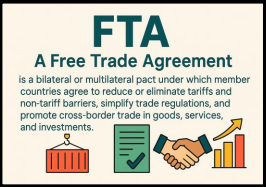
• India and the United Kingdom have signed the Comprehensive Economic and Trade Agreement (CETA), a
bilateral free trade agreement marking a major milestone in their longstanding partnership.
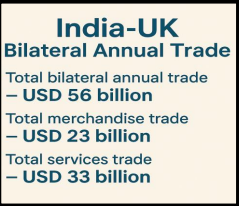
• It reflects the shared ambition of two major economies to deepen economic ties. Bilateral trade has already reached
USD 56 billion, with a target to double this by 2030.
Key Features of the India–UK Free Trade Agreement
Goods and Agriculture
Tariff-Free Market Access: 99% of Indian manufactured goods enter the UK without import duties.
Duty Reductions on UK Products: Whisky tariffs cut to 40% and car duties to 10% over 10 years.
Marine Products Boost: 99.3% of Indian seafood exports (shrimp, tuna, etc.) are duty-free.
Agricultural Gains: 95% of farm products and 99.7% of processed foods get zero-duty access.
GI Recognition: Feni, Nashik wine, and Kerala toddy receive UK Geographical Indication status.
Simplified Rules of Origin
Self-Certification: Exporters can certify product origin themselves, reducing paperwork and time.
Importer’s Knowledge Option: UK importers can rely on their own knowledge for origin certification.
Small Consignment Relief: No origin documentation needed for consignments under £1,000, boosting e-commerce and small business exports.
Supply Chain Alignment: Product-Specific Rules of Origin match India’s existing supply chains in textiles, machinery, pharmaceuticals, and processed food.
Services and Mobility
Expanded Professional Access: Liberalised entry for Indian IT, legal, finance, and architecture professionals.
Special Visa Quota: 1,800 annual UK visas for chefs, yoga instructors, musicians, and other cultural experts.
Simplified Business Travel: Easier short-term service entry and intra-company transfers.
Pension Portability: Double Contribution Convention prevents dual social security payments.
Investment and Public Procurement
UK Procurement Access: UK firms eligible for Indian government contracts above ₹200 crore as Class II suppliers.
Local Sourcing Requirement: Minimum 20% UK-origin inputs for procurement eligibility.
Investor Protection: International arbitration allowed after one year of unsuccessful consultations.
Digital and Technology Cooperation
Paperless Customs: Electronic documentation and digital authentication for trade clearance.
Cross-Border Data Flows: Permitted with safeguards; no forced data localisation.
Source Code Safeguards: No obligation to share proprietary algorithms or code.
Critical Minerals Collaboration: UK funds £1.8M IIT Dhanbad project to map global digital supply chains.
Double Contribution Convention (DCC)
Social Security Savings: Exempts Indian workers and employers from paying UK social security contributions for up to three years on temporary assignments.
Impact: Expected to benefit 75,000 workers and 900+ companies.
Economic Gain: Estimated savings of over ₹4,000 crore.
Significance of the India–UK Free Trade Agreement
Market Access Breakthrough: Grants India near-total tariff-free entry into the UK, giving its exporters a stronger foothold in one of the world’s largest consumer markets.
First-of-its-Kind Mobility Provisions: Eases professional movement for Indian talent across IT, finance, healthcare, and education, alongside cultural sectors like cuisine and yoga.
Cost Efficiency for Businesses: The DCC eliminates duplicate social security payments, saving companies and workers substantial costs.
Trade Process Modernisation: Simplified rules of origin, paperless customs, and digital authentication reduce trade friction, especially for MSMEs and e-commerce.
Balanced Liberalisation: Protects sensitive Indian sectors while still offering gradual market opening for UK exports, ensuring domestic capacity-building isn’t compromised.
Strategic Collaboration: Deepens cooperation in critical minerals, technology, and innovation, supporting India’s energy transition and manufacturing upgrade.
Concerns Associated with the India–UK FTA (for India)
Public Health Risks: Tariff-free entry for UK processed foods (biscuits, chocolates, soft drinks) could encourage unhealthy consumption.
Agricultural Sensitivities: Gradual tariff cuts may expose farmers in dairy, cereals, pulses, and fruits/vegetables to competitive pressure.
Manufacturing Competition: Lower tariffs on premium goods like cars and whisky could hurt domestic producers.
Standards and Compliance Barriers: Differences in food safety, quality norms, and labelling may limit India’s ability to utilise full market access.
Trade Balance Pressure: India exports low- to mid-value goods, while UK exports high-value items, potentially widening trade gap.
Professional Mobility Limitations: UK immigration policy changes could restrict flow of Indian professionals.
Cultural and Dietary Impact: Increased penetration of foreign processed foods may threaten India’s traditional food diversity.
Way Forward
Create a “UK Gateway” Strategy to position India as the UK’s hub for ASEAN, Africa, and Middle East supply chains.
Launch FTA-linked skill missions in green tech, design services, and legal consulting to capture high-skill jobs.
Establish a Joint IP & Innovation Fund for AI, climate tech, and life sciences startups.
Promote sustainable trade branding with “Green & Ethical India” labels.
Implement a Digital Customs Corridor with blockchain-enabled clearance between Indian and UK ports.
Expand Global Capability Centres (GCCs) to new sectors like aerospace, animation, and fintech.
Use mobility provisions to expand India’s cultural economy (cuisine, wellness tourism, performing arts).
Build a Critical Minerals Alliance with the UK to support renewable energy transition.
Conclusion
The India–UK FTA is more than a trade pact; it is a strategic roadmap for shared prosperity, reflecting trust, mutual respect, and forward-looking vision. As PM Modi stated, “This Agreement is not just an economic agreement but also the plan for a shared prosperity.” It is a testament to the enduring partnership between India and the UK, poised to create opportunities for businesses, workers, and communities in both nations.
Question for Practice:
Examine the significance of the India–UK Free Trade Agreement in the context of India’s strategic and economic diplomacy. (15 Marks, 250 Words)
Silver Economy and India’s Aging care
Tags :
News Context:
• India’s rapidly aging population, projected to equal the US population by 2050, is straining its healthcare system, with nearly 80% of lifetime healthcare costs incurred in the last five years of life.
What is silver economy?
• The Silver Economy refers to the economic opportunities and services associated with the aging population, typically people aged 60 and above. The term “silver” symbolizes the grey hair commonly associated with older adults.
• India is underscored by demographic shifts that are reshaping the nation’s social landscape.
• According to the Report of the Technical Group on Population Projections (July 2020), India’s elderly population is expected to reach 193.4 million by 2031. This dramatic increase from the 103.8 million senior citizens recorded in the 2011 Census, which represented 8.6% of the total population at that time, highlights the urgency of addressing issues related to healthcare, economic security, and social integration for older adults.
Syllabus of Mains – GS-II- Welfare Schemes for Vulnerable Sections of the population by the Centre and States and the Performance of these Schemes
Necessity of Silver economy
• Aging Population Is Rapidly Growing: By 2050, over 2 billion people globally will be over the age of 60. In India, seniors will make up nearly 20% of the population by 2050 (approx. 319 million people). This shift creates huge demand for age-specific services, infrastructure, and support.
• Elderly Are Becoming a Major Economic Force: Older adults control a large portion of personal wealth and are active consumers. Globally, the “silver market” was worth $15 trillion in 2020, projected to reach $27 trillion by 2030. Seniors increasingly spend on healthcare, wellness, technology, travel, and housing.
• Rising Demand for Geriatric Healthcare: Seniors have specific health needs (chronic illnesses, mobility, mental health).
• Encouraging Active and Dignified Aging: The Silver Economy promotes independence and quality of life through: Age-friendly products, Senior living communities, Accessible infrastructure, financial planning tools.
• Re-engaging Seniors in the Workforce: Many seniors are healthy, experienced, and willing to contribute post-retirement. The economy benefits when older adults are employed, volunteering, or mentoring—instead of being seen only as dependents.
Key Challenges of the Silver Economy
• Healthcare System Limitation: Shortage of geriatric specialists and trained caregivers. Overburdened public healthcare infrastructure, especially in rural and low-income areas. Lack of preventive care models tailored to aging-related diseases (e.g. dementia, arthritis, cardiovascular diseases).
• Inadequate Age-Friendly Infrastructure: Urban spaces, public transport, and housing are often not designed for seniors (e.g. stairs, poor lighting, no handrails). Lack of dedicated senior housing assisted living, or community spaces for social engagement.
• Digital Divide: Many elderly individuals struggle with using modern technology, including smartphones, digital payments, or telemedicine. Tech solutions are often not senior-friendly (complex interfaces, small text, fast-paced UX). Risk of cyber fraud targeting vulnerable seniors.
• Social Isolation and Mental Health: Seniors, especially those living alone or in urban settings, often suffer from loneliness and depression. Lack of community engagement programs and social support networks. Mental health remains underdiagnosed and undertreated in aging populations.
• Policy and Regulatory Gaps: Absence of comprehensive, long-term policies focused on the Silver Economy. Fragmented governance—multiple ministries handle elderly care with poor coordination. Underfunded welfare schemes and low awareness among the elderly about benefits.
• Lack of Market Awareness & Investment: Businesses often overlook the senior demographic in product design and marketing. Limited venture capital and innovation targeting eldercare or silver tech. Misconception that seniors are not an economically “attractive” segment.
Government Measures for Geriatric Care in India
• Policy Frameworks & Legal Measures
National Policy on Older Persons (1999)
Ensures economic and health security.
Promotes shelter, welfare, and protection of elderly.
Encourages private and voluntary sector participation in elder care.
Maintenance and Welfare of Parents and Senior Citizens Act (2007)
Makes it legally mandatory for children/relatives to provide maintenance to elderly parents.
Enables seniors to claim maintenance through tribunals.
Provides for establishment of old age homes in every district.
• Financial Support Schemes
Atal Vayo Abhyudaya Yojana (AVYAY): (Department of Social Justice and Empowerment)
Integrated Programme for Senior Citizens (IPSrC): Senior Citizens’ Homes for 25 destitute Senior Citizens. Senior Citizens’ Homes for 50 Elderly Women (including under SAGY). Continuous Care Homes for Senior Citizens with Alzheimer’s/Dementia.
State Action Plan for Senior Citizens (SAPSrC): Collaboration with State/UT Governments to develop and implement State Action Plans for senior citizens’ welfare.
Rastriya Vayoshri Yojana (RVY): Provision of physical aids and assisted living devices to senior citizens, especially those in the BPL category.
Livelihood and Skilling Initiatives for Senior Citizens: Senior Able Citizens for Re-Employment in Dignity (SACRED): Portal for re-employment opportunities for senior citizens.
Conclusion
• The Silver Economy is not just about addressing the needs of the elderly—it’s about reimagining aging as a pillar of economic growth, social resilience, and innovation. With rising life expectancy and improved healthcare, senior citizens are living longer, healthier, and more active lives. This demographic transformation presents a golden opportunity to build inclusive systems that recognize seniors as valuable contributors to society.
Mains questions for practice:
• “India’s demographic dividend is gradually giving way to a ‘silver tsunami’. In this context, evaluate the preparedness of India’s economy and policy framework to harness the potential of the Silver Economy.” (10 Marks, 150 words)
Key Components of Crowd Disaster Management
Pre-Event Planning
● Risk Assessment: Site analysis, route mapping, capacity estimation
● Crowd Modelling: Use of GIS and AI to predict human movement
● Permissions & SOPs: As per NDMA guidelines
● Infrastructure Readiness: Barricades, signage, PA systems, lighting
Stakeholder Coordination
● Unified Command Structure: Police, district admin, fire services, NDRF
● Training & Deployment: Trained marshals, volunteers, security personnel
● Inter-agency Mock Drills: Ensures coordinated response
Real-time Monitoring
● Surveillance Cameras & Drones for visual tracking
● Crowd Counting Systems (RFID, AI, heat maps)
● Communication Systems: Loudspeakers, SMS alerts, public address systems
Emergency Response
● Clear Evacuation Plan: Multiple entry/exit points
● First Aid Posts & Emergency Medical Teams
● Mobile Rescue Units
● Panic Control Measures

General Studies III
India–U.S. Trade Tensions
Tags :
News Context
• After doubling tariffs on India to 50% over Russian oil imports, U.S. President Donald Trump recently indicated that he may even pause trade talks between the two countries until the oil issue was ‘resolved’.
Strategic and Economic Triggers for Recent U.S. Tariff Moves
• Tariffs as Geopolitical Leverage: The US move is not only for economic protection but also as a tool of political and security pressure, e.g., responding to India’s continued purchase of Russian oil or signalling displeasure over specific policy choices by other nations.
• National Security and Anti-Illicit Trade Justifications: Tariffs are being framed as part of a broader national emergency approach, targeting countries linked to illicit activities such as fentanyl trafficking and other security threats.
• Reviving Domestic Manufacturing and Reducing Trade Deficit: The measures aim to address long-standing trade imbalances, protect sensitive industries like steel, aluminium, autos, and semiconductors, and promote domestic production.
• Negotiation Tactic: The sudden tariff threat may be aimed at extracting concessions in stalled trade talks.
Potential Economic and Strategic Impact of U.S. Tariff Moves on India
Economic Impact:
• Export Competitiveness Erosion: Higher tariffs on Indian goods (e.g., textiles, engineering products, gems, and jewelry) reduce price competitiveness in the U.S. market, risking loss of market share to competitors like Vietnam, Bangladesh, and Mexico.
• Pressure on Key Sectors: Labour-intensive sectors such as textiles, leather, and gems could face order cancellations, directly impacting employment and foreign exchange earnings.
• Trade Balance Strain: India’s trade surplus with the U.S. could narrow sharply, impacting overall export growth and current account stability.
• Supply Chain Disruptions: Export-oriented MSMEs dependent on U.S. demand could face raw material and inventory buildup, leading to liquidity stress.
• Currency Volatility: Potential capital outflows and reduced export earnings may increase pressure on the rupee, affecting import costs (especially crude oil).
• Economic Growth Prospects: As per Moody’s Ratings, U.S. President Donald Trump’s steep 50% tariffs on Indian imports could severely undermine India’s manufacturing ambitions and slow economic growth.
Strategic & Geopolitical Impact:
• Strained Bilateral Trade Relations: Tariffs may derail ongoing trade negotiations (e.g., India-U.S. FTA), delaying tariff rationalisation and market access gains.
• Impact on Strategic Convergence: Economic tensions could spill over into other cooperative areas such as defence technology sharing, critical minerals supply chains, and climate finance.
• Push Towards Diversification: India may accelerate market diversification towards the EU, ASEAN, Africa, and Latin America to reduce dependence on the U.S. market.
• Domestic Policy Pressure: Could push India towards greater self-reliance (Atmanirbhar Bharat) in high-value manufacturing, but with short-term adjustment costs.
• Potential Leverage in Multipolar Diplomacy: India might leverage this tension to strengthen ties with other major economies, using platforms like BRICS, SCO, and the Global South to build coalitions against protectionist measures.
Potential Impact of U.S. Tariff Moves on Indian Exports
• Loss of Price Competitiveness: Higher tariffs make Indian goods costlier in the U.S. market, reducing their attractiveness compared to low-cost competitors like Vietnam, Bangladesh, and Mexico.
• Decline in Export Volume: Labour-intensive sectors (e.g., textiles, apparel, gems & jewelry, leather) could see order cancellations and reduced shipments.
• Revenue & Employment Losses: MSME-dominated export clusters may face revenue contraction, leading to job losses, especially in states like Gujarat, Tamil Nadu, and Maharashtra.
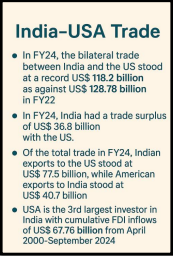
• Trade Surplus Reduction: India’s trade surplus with the U.S.—its largest export destination—could narrow, affecting overall export growth and foreign exchange reserves.
• Shift in Supply Chains: U.S. buyers may diversify sourcing away from India, leading to a long-term erosion of market share in certain product categories.
• Pressure on High-Value Exports: Sectors like pharmaceuticals, engineering goods, and processed foods could face competitive disadvantages despite their quality edge.
• Currency & Cost Pressures: Lower export earnings may add pressure on the rupee, increasing import costs for inputs and raw materials, further raising export production costs.
Way Forward – Mitigating the Impact of U.S. Tariffs on Indian Exports
• Diversify Export Markets: Reduce dependence on the U.S. by strengthening trade ties with the EU, ASEAN, Africa, Latin America, and West Asia through targeted FTAs and export promotion missions.
• Upgrade Product Competitiveness: Invest in quality certification, R&D, and technology adoption to shift towards high-value, innovation-driven exports less vulnerable to price-based competition.
• Negotiate Trade Concessions: Engage diplomatically with the U.S. to seek tariff exemptions for strategic sectors, leveraging mutual interests in defence, clean energy, and critical minerals.
• Boost Domestic Manufacturing Ecosystem: Strengthen Atmanirbhar Bharat initiatives to enhance domestic supply chains, reduce input dependency, and improve cost efficiency for exporters.
• Leverage Multilateral Platforms: Use WTO dispute mechanisms and coalition-building with other affected countries to challenge unilateral tariff hikes and advocate fair trade norms.
Conclusion
• As C. Rangarajan, former Chairman of the Economic Advisory Council to the Prime Minister, notes, the U.S. tariff step is merely an opening gambit in a longer negotiation. Lasting trade solutions cannot be built on threats or mistrust. India must therefore pursue constructive engagement with the U.S. to address concerns on both sides, while championing through the WTO a low-tariff, rules-based trading system. Recognising that regional agreements, though a second-best option, remain necessary in the current global climate.
Questions for Practice:
• Assess the potential long-term economic impact of recent U.S. tariff measures on Indian exports. How should India recalibrate its trade strategy to mitigate these effects while sustaining export-led growth? (15 M, 250 Words)
Bharat Forecast System
Tags :
News Context:
• The India Meteorological Department (IMD) adopted the Bharat Forecast System (BFS), an indigenously developed weather prediction model boasting a 6-kilometre resolution grid.
• Union Minister of Earth Sciences Dr. Jitendra Singh inaugurated the world’s first indigenously developed high-resolution weather forecast systems at a launch ceremony held at Vigyan Bhawan.
What is Bharat Forecast System?
• High-resolution, indigenous model: Developed by the Indian Institute of Tropical Meteorology (IITM), Pune, under the Ministry of Earth Sciences, BFS operates at a fine 6 km × 6 km grid — a significant upgrade from the previous 12 km grid used by IMD.
• Global-first precision: It is currently the highest-resolution operational global numerical weather prediction system in existence.
key reasons behind launching this advanced system:
• Inadequacy of Existing Systems:
o This was insufficient for village-level forecasting, especially in a country with diverse topography, microclimates, and extreme weather variability.
o It couldn’t predict localized extreme events (like cloudbursts, flash floods, or intense heatwaves) with the needed precision.
• Increasing Frequency of Extreme Weather Events:
o India is experiencing more frequent and intense such as Cyclones, Floods, Droughts, Heatwaves.
o These events cause significant loss of life, damage to crops, infrastructure, and economic activity.
• Critical Need for Agro-Meteorological Services:
o Over 60% of India’s population is dependent on agriculture, which is highly weather-sensitive.
o Farmers need hyperlocal, real-time data to: Decide sowing and harvesting times Schedule irrigation, Prepare for storms, drought, or excess rainfall.
• Technological Sovereignty & Indigenous Capability:
o India was dependent on foreign weather models (e.g., UK, US).
o BFS, developed indigenously, is part of India’s “Atmanirbhar Bharat” and “Make in India” vision.
o It ensures self-reliance in critical weather and climate tech, reducing dependency on external models.
• Leverage of Advanced Computing Infrastructure:
o The launch of India’s powerful new supercomputer “Arka” enables faster processing of large datasets and simulations.
o BFS uses this to cut forecast generation time drastically (from 10–14 hours to just 4–6 hours).
o This allows faster decision-making in time-critical situations.
Global Weather Forecasting Techniques:
• Numerical Weather Prediction (NWP):
o Most widely used method globally.
o Uses complex mathematical models to simulate the atmosphere using: Temperature, Pressure, Wind speed/direction, Humidity, etc., Requires supercomputers and vast data from satellites, radars.
India Meteorological Department (IMD)
• Established: January 15, 1875
• Headquarters: Mausam Bhavan, Lodhi Road, New Delhi
• Parent Ministry: Ministry of Earth Sciences (MoES), Government of India
• Director General (as of 2025): Dr. Mrutyunjay Mohapatra (also known as “Cyclone Man of India”).
Mandate and Core Functions
• The IMD is the national agency responsible for
o Weather forecasting and monitoring
o Seismology (earthquake detection)
o Meteorological observations
o Climate research
o Warnings for natural disasters (cyclones, floods, heatwaves, etc.
• Statistical Forecasting:
o Based on historical weather data and statistical patterns.
o Often used for climate outlooks (monthly or seasonal forecasts).
o Examples: Regression analysis, time series models, analog methods ground stations.
• Satellite Meteorology:
o Weather satellites (like NOAA, METEOSAT, INSAT, Himawari) provide-Cloud cover, Sea surface temperatures, Cyclone tracking, Rainfall estimates, Essential for remote or oceanic areas.
• Radar-Based Nowcasting:
o Short-term (0–6 hours) forecasting of thunderstorms, rain, hail, etc.
o Uses Doppler Weather Radars (DWRs) to track: Rain cells, Storm movement, Lightning activity, Widely used in urban and airport meteorology.
Major challenges to weather forecasting:
• Complexity of the Atmosphere: The atmosphere is a chaotic, non-linear system, meaning small changes in one variable can lead to huge differences in outcomes (the butterfly effect). Forecasts become less reliable the farther out they go in time—especially beyond 7–10 days.
• Incomplete and Uneven Observational Data: Sparse or low-quality data in certain regions (e.g. oceans, remote mountains, conflict zones) leads to less accurate inputs. Developing countries often lack enough Doppler radars, weather stations, or high-resolution satellite access.
• Limitations of Forecast Models: Models rely on assumptions and simplifications of real-world physics. Resolution limits (grid sizes like 12 km or more) mean small-scale features like thunderstorms or tornadoes can be missed or poorly represented. Errors in initial conditions or boundary data can grow over time, reducing accuracy.
• Time Constraints for Real-Time Forecasting: Accurate forecasts need to be delivered quickly, often within a few hours. Processing massive data through supercomputers (like India’s “Arka”) takes time, and delays can render forecasts obsolete.
• Difficulty in Predicting Extreme Events: Events like cloudbursts, flash floods, hailstorms, urban heatwaves, and lightning are highly localized and fast-evolving. Forecasting such events with high spatial and temporal precision is still a global challenge.
Conclusion:
• In a country where over 60% of the population depends on weather-sensitive sectors like agriculture, and where extreme weather events are becoming more frequent, BFS is more than just a technological upgrade—it is a tool for climate resilience, rural empowerment, and disaster risk reduction.
• By embracing home-grown innovation, India reduces its dependency on foreign models and affirms its capability to lead on the global meteorological stage. The system empowers farmers, supports smart urban planning, strengthens early warning systems, and brings forecasting down to the level of villages and panchayats.
• “Forecasting the future is not about prediction—it’s about preparation.” — Dr. Mrutyunjay Mohapatra, DG, IMD
Mains questions for practice:
• “The Bharat Forecasting System represents a paradigm shift in India’s weather prediction capabilities.” Discuss its significance for disaster preparedness, agriculture, and climate resilience. (10 Marks, 150 words)
• This significant military victory, known as Operation Vijay, marked the successful defence against Pakistani forces that had intruded into Indian territory across the Line of Control (LoC) in the Kargil district of Jammu and Kashmir.
International Tiger Day – 29 July 2025
• International Tiger Day is celebrated on July 29 every year. This day is dedicated to identifying and promoting global efforts taken to protect the tiger.
• The history of Global Tiger Day dates back to 2010. During a summit held in St. Petersburg, the governments from tiger range countries came together and decided to double the wild tiger population by 2022.