
June 1'st Week
Print PDF
Urban Floods
Tags :
News Context :-
Indian cities have a drainage problem. Indian cities are experiencing frequent urban flooding due to unplanned urbanisation.
Data/Statistics :-
- Urban drainage refers to the system of natural and man-made infrastructure—like stormwater drains, channels, and retention systems—used to collect, convey, and dispose of excess rainwater.
- Over 70% of urban areas lack scientifically planned stormwater drains.
- Mumbai has stormwater drains dating back to the 1860s, designed for 25 mm/hour rainfall, while the city frequently sees over 100 mm/hour. 80% of its natural water bodies have disappeared in last 40 years.
- Delhi’s drainage systems follow 1976 norms, designed for 50 mm/day rainfall. In May 2025, the city received 185.9 mm in one day, more than 9 times the norm.
- Bengaluru lacks a natural river system and has outdated, narrow drains. Over 65% of interlinked lakes (e.g., Bellandur) are now encroached and concretised, severely limiting water retention.
Causes of Urban Drainage Failure: -
Natural Causes: –
- Intensifying Rainfall: Climate change is causing a sharp rise in short-duration, highintensity rainstorms. E.g. In 2023, Delhi received 100 mm+ rainfall in less than an hour, overwhelming the city’s drainage.
- Low-lying Terrain: Cities like Mumbai and Bengaluru are naturally prone to waterlogging due to their topography.
- Tidal Effects and Sea-Level Rise: Coastal cities like Chennai and Mumbai face backflow in drains during high tides, hindering rainwater discharge.
- Silting of Natural Water Channels: Natural rivers, lakes, and nullahs get choked with silt and debris, reducing their capacity to carry stormwater.
- Loss of Natural Absorption Zones: Shrinking wetlands, forests, and open areas reduce groundwater recharge and increase surface runoff.
Man-made Issues: -
- Unplanned Urbanisation: Rapid growth has led to the encroachment of floodplains, concretisation, and reduced soil permeability—increasing surface runoff.
- Outdated Design Standards: Most urban drainage systems are built for a 1 in 2 year flood event, which is woefully inadequate for today’s rainfall patterns.
- Illegal Constructions: Unauthorized structures over drains prevent access and hinder maintenance and desilting.
- Sewage Infiltration: In many cities like Patna and Bhopal, stormwater drains are contaminated with sewage due to poor or non-existent separate sewerage lines.
Government Initiatives to Tackle Drainage Crisis: -
- AMRUT 2.0 Scheme: Advocates for integrated stormwater networks, protection ofwater bodies, and emphasis on rainwater harvesting around them
- Jal Shakti Abhiyan & Atal Bhujal Yojana: Promote groundwater recharge using check dams and urban recharge pits, reducing surface runoff and improving stormwater
absorption. - Model Building Bye Laws (MBBL), 2016: Rainwater harvesting is mandated for plots over 100 sq. meters, aiming to reduce runoff and improve aquifer recharge.
- Amrit Sarovar Mission: Aims to rejuvenate urban waterbodies, improving their capacity to retain stormwater and act as natural buffers during heavy rainfall.
- Manual on Stormwater Drainage Systems (2019): Recommends cities design drains for 1-in-5 or 1-in-10-year events rather than outdated 1-in-2 models, accounting for
changing rainfall patterns due to climate change. - GIS-Based Drainage Mapping: Cities like Delhi are adopting simulation-based frameworks using GIS technology to dynamically redesign drainage systems based on real-time land use, population, and rainfall data.
Way Forward: -
Strict Enforcement of Building Codes:
- Ensure strict adherence to MBBL and zoning laws, especially in high-density urbanareas.
Decentralised Drainage Solutions:
- Encourage rooftop gardens, bioswales, and permeable pavements to naturally manage runoff and reduce load on drainage systems.
Underground Storage Systems:
- Construct rainwater retention tanks under parks and public spaces to capture and slowly release stormwater.
Routine Desilting and Maintenance:
- Implement a strict maintenance regime, ensuring timely desilting and unclogging, especially for covered or encroached drains.
Community Awareness Campaigns:
- Conduct public outreach to reduce waste dumping in drains, encourage water conservation, and promote local-level solutions like harvesting.
Conclusion: -
Urban flooding in India is no longer a seasonal nuisance but a chronic governance and planning failure. According to NITI Aayog, unplanned urban expansion, inadequate drainage infrastructure, and loss of natural water bodies have significantly increased flood vulnerability.
The Second Administrative Reforms Commission (ARC) also highlights poor coordination between urban local bodies, lack of data-driven planning, and weak enforcement of land-use norms as key contributors.
Urban flooding is both a development and disaster management challenge — demanding urgent and systemic reforms to make Indian cities safe, sustainable, and resilient.
Women in Defence Forces
Tags :
Context: -
- Transformative milestone in NDA’s nation-building legacy: First-ever batch of 17 Female Cadets pass out from NDA after completing 148th Course.
- Women officers, including Col. Sofiya Qureshi and Wg Cdr. Vyomika Singh played a key role in Operation Sindoor, highlighting their leadership in military strategy.
- Lt. Cdrs. Dilna K and Roopa A completed Navika Sagar Parikrama II, a 25,600- nautical-mile expedition, proving women’s endurance in maritime defence.
History of Women in Indian Armed Forces: -
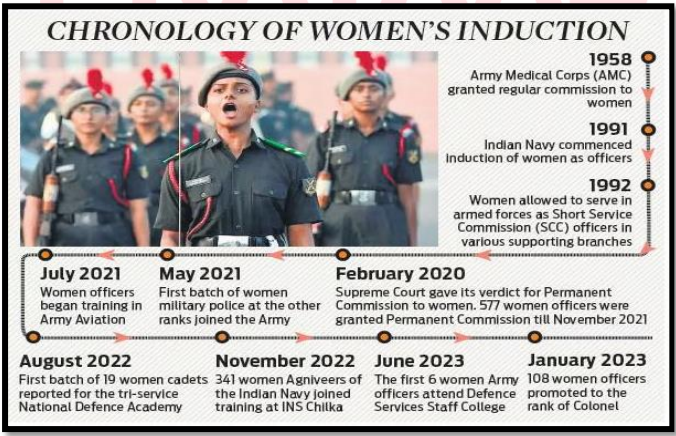
- The induction of women officers into the Indian Army through the Women Special Entry Scheme (WSES) started in 1992, after the approval of the Cabinet Committee on Parliamentary Affairs.
- In 2006, the WSES scheme was replaced by the SSC (Short Service Commission) scheme for women. Existing WSES officers were given the option to move to the new scheme.
- In 2019, the government granted permanent commission to women officers in eight streams of the Army.
- In 2020, SC, in ‘Secretary, Ministry of Defence vs. Babita Puniya’ upheld the demands of women in the SSC and granted Permanent Commission or a full-length career to women in Army.
- In 2021, Indian army started to induct women in short service commission as fighter pilots.
- The Indian Air Force and Navy now allow women in all roles including combat.
Current Status: –
- Women Agniveers: The Agnipath scheme (launched in 2022) includes women recruits in all three Services (Army, Navy, and Air Force), signalling a paradigm shift in recruitment norms.
- Current status of Women in Armed Forces: In India’s over one million-strong Army, women comprise only about 4% of the force, compared to 16% in the US.
- Over 8,000 women personnel are serving in the Indian Army at present followed by more than 1,800 in the Indian Air Force and 900 plus in the Navy, as per data provided by GoI in March 2024.
Importance of Women in Armed Forces: –
- Diversity of thought and experience: Women bring diverse perspectives and problem-solving approaches to the table, fostering creativity and innovation leading to better decision-making and improved mission outcomes.
- Enhanced operational capabilities: Modern warfare relies heavily on technology, communication, and intelligence gathering. Women often excel in these areas, contributing significantly to the operational capabilities of the armed forces.
- Stronger social cohesion: Women’s presence can foster better understanding and communication between different communities and cultures, both within the forces and during deployments.
- Meeting recruitment challenges: Including women in the armed forces broadens the talent pool, allowing militaries to access a wider range of qualified recruits to meet their needs.
- Role models and inspiration: Seeing women excel in leadership roles and challenging traditional stereotypes inspires future generations, both within the military and in broader society.
Challenges Faced by Women in Armed Forces
- Deep-seated stereotypes and biases
- Low acceptance for women officers
- Sexual assault and harassment
- Pregnancy, post-partum recovery, and motherhood
- A lack of rules and regulations for women officers
Women in Defence: Situation in Other countries
- Women officially became eligible for combat positions in the American military in 2013.
- In 2018, the UK military lifted a ban on women serving in close combat ground roles, clearing the way for them to serve in elite special forces.
- Israel has gradually opened up 90% of its roles to women but they are still excluded from frontline combat roles in the main infantry units and some of the most elite commando units that traditionally operate across enemy lines in wartime.
Conclusion: –
- India is moving towards greater gender inclusivity in its defence forces. However, policy changes and societal mindsets need to evolve further to allow women equal opportunities to serve in all capacities.
China’s Brahmaputra Dams
Tags :
News Context: –
- To counter “Pakistan’s scare narrative” about Chinese dams on the Brahmaputra, Assam Chief Minister Himanta Biswa Sarma has pointed out that “65-70% [of the Brahmaputra’s flow] is generated within India, and “even if China were to reduce water flow, it may actually help in mitigating the annual floods in Assam”.
Data/Facts: –
- China has planned Medog (or Motuo) Hydropower Project, in Medog County near the ‘Great Bend’ where Brahmaputra (Yarlung Tsangpo) makes a Uturn and plunges into a canyon before entering Arunachal
Pradesh. - The planned 60,000-MW Medog project will be the world’s largest hydropower facility, with a generation capacity three times that of Three Gorges Dam, currently the world’s largest hydropower station.
Impact of China’s upstream interventions on India: -
Seismic Risks:
- Construction of large dams and reservoirs increases the risk of earthquake-induced dam failure or landslides, aggravating disaster vulnerability.
Geopolitical & Strategic Concerns:
- China has used water control as a geopolitical tool, withholding critical hydrological data during tense moments (e.g., 2017 Doklam standoff).
- Due to the absence of binding water-sharing treaty between India and China for Brahmaputra, control over upstream water flow gives China strategic leverage in regional politics and security.
Hydrological Risks:
- Most Chinese dams are run-of-the-river projects with minimal water storage, but they can still affect river flow impacting hydropower projects in Assam and downstream states.
Agricultural Impact:
- Large dams may trap silt and sediments, which normally enrich the fertile floodplains. This can lead to reduced soil fertility in agricultural regions of Assam and West Bengal.
Ecological impact:
- Disruption of fragile Himalayan ecosystem due to altered water flow & habitat changes. Sudden release of stored water can lead to flash floods, threatening floodprone areas like Assam.
- Increased risk of Glacial Lake Outburst Floods (GLOFs), potentially triggered by daminduced changes.
Steps taken by India: -
Hydropower Projects:
- Upper Siang Project: A multipurpose dam aimed at regulating water flow and generating clean hydroelectric power to balance upstream interventions.
- Dibang Valley Project (10 GW capacity): One of India’s largest hydropower initiatives designed to counterbalance China’s infrastructure build-up on the Brahmaputra.
- River-Linking Projects: Manas–Sankosh–Teesta–Ganga Link and Jogighopa–Teesta– Farakka Link. Both projects aim to transfer surplus water from Brahmaputra tributaries to the Ganga basin.
Data Sharing Mechanisms:
- Expert Level Mechanism: Established in 2006 to facilitate hydrological data sharing, although effectiveness is limited.
- MoUs on Brahmaputra & Sutlej: The Brahmaputra MoU lapsed in 2023 (renewable every 5 years), raising concerns over transparency. An Umbrella MoU signed in 2013 remains valid but lacks binding enforcement.
Way Forward: -
Scientific & Strategic Monitoring:
- Conduct continuous assessment of flow variations, sedimentation, and seismic risks linked to upstream dams.
Scientific & Hydro-Diplomacy:
- Advocate for a treaty-based, legally binding water-sharing agreement with China to ensure transparency and equitable usage. Promote multilateral cooperation involving India, China, Bangladesh, and Bhutan to manage Brahmaputra basin resources jointly.
Scientific & Disaster Preparedness:
- Strengthen early-warning systems for floods & dam-related emergencies. Develop flood-resilient infrastructure in flood-prone Assam & northeastern states to mitigate risks.
Ecological Safeguards:
- Preserve riverine biodiversity, wetlands, and forests to maintain ecological balance. Monitor environmental changes like desertification in Tibet, which could worsen water scarcity downstream.
Conclusion: –
- As freshwater scarcity rises due to climate change, overuse, and geopolitical tensions, water is emerging as a key strategic resource. Experts warn that future conflicts may not be over land or oil, but over rivers, dams, and access to clean water. To avoid such “water wars,” nations must adopt cooperative hydro-diplomacy, strengthen transboundary treaties, and ensure sustainable, equitable sharing of water resources. Peace depends on water security.
India- World’s 4th Largest Economy
Tags :
News Context: –
- NITI Aayog, the Union government’s policy body for transforming India, announced that the Indian economy had overtaken Japan to become the world’s fourth-largest economy, following the USA, China and Germany.
India’s Economic Growth Snapshot
- India’s nominal GDP is set to reach $4,187 billion, surpassing Japan ($4,186 billion), though per capita GDP remains low at $2,880 vs. Japan’s $33,900.
- India is the fastest-growing major economy, with over 6% annual growth projected for the next two years.
- IMF projects India will become the 3rd largest economy by 2028, overtaking Germany, with a GDP of $5.58 trillion.
Key Drivers of India’s Economic Rise: -
Expanding Domestic Consumption: –
- Private consumption forms ~60% of GDP, with notable rural growth.
- Urban population projected to hit 600 million by 2030 (UN); rising middle class and youth spending fuel demand.
Demographic Dividend: –
- Median age of 29 ensures a young, productive workforce for decades.
Infrastructure & Digital Transformation: –
- Massive investments in transport, energy, and Digital Public Infrastructure (Aadhaar, UPI).
- India Stack and JAM (Jan Dhan-Aadhaar-Mobile) promote digital and financial inclusion.
Global Realignment & FDI: –
- “China Plus One” and Supply Chain Resilience Initiative attracting FDI (e.g. Apple, Samsung).
- Strategic partnerships with Japan, QUAD nations boost India’s appeal.
Reform-Led Growth: –
- GST created a unified market; IBC improved credit discipline.
- Corporate tax cuts (22% for existing firms, 15% for new manufacturers) enhance business ease.
Key Challenges for India’s Economic Growth: -
Geopolitical Uncertainty: –
- Supply Chain Disruptions: Russia-Ukraine war & Red Sea crisis have raised shipping costs by up to 300%.
- US-China Rivalry: Disrupting global tech and semiconductor supply chains.
- Export Volatility: Sectors like textiles and electronics face global demand shocks and trade barriers.
Inflation & Price Volatility: –
- Stubborn Core Inflation: April 2025 CPI eased to 4.8%, but services inflation remains ~6%.
- Food & Fuel Stress: Unseasonal rains and global crude (~$80/barrel) pressure household budgets.
- Urban Living Costs: Rising housing and transport expenses limit discretionary spending.
Employment & Workforce Issues: –
- Automation Threat: AI/robotics displacing repetitive jobs; 400 million workers need upskilling by 2030 (NASSCOM).
- Informal Employment: Over 80% workforce lacks job and social security.
Trade & Export Headwinds: –
- Current Account Deficit: Narrowed to 1% of GDP in FY24–25, helped by services and remittances.
- Merchandise Export Decline: Down 4.6% YoY in FY25 due to weak global demand.
Infrastructure & Investment Gaps: –
- Capex-to-GDP at 3.3% – highest in a decade (Budget 2024–25), but more needed.
- Green Infrastructure: Greater push needed in solar, wind, and battery tech for Net Zero 2070.
- Urban Infra: Smart Cities and PM Gati Shakti require faster rollout and private sector support.
Way Forward for India’s Economic Growth: -
Scientific & Diversify Trade Partnerships:
- Reduce dependence on China, EU, and US by expanding FTAs with Africa, ASEAN, and Latin America to access new markets and resources.
Boost Manufacturing:
- Develop sectors like semiconductors, EVs, drones, and green hydrogen; support MSMEs with credit, tech, and skill development to integrate into global value chains.
Enhance Digital & Financial Inclusion:
- Expand 5G, AI, and platforms like UPI and ONDC beyond urban areas; strengthen cybersecurity and data governance.
Promote Sustainable & Inclusive Growth:
- Invest in climate-smart agriculture, reduce inequality, and enhance education, R&D, and innovation to ensure long-term, inclusive development.
Conclusion: –
- India’s economic ascent is driven by strong fundamentals—robust consumption, a young workforce, and digital innovation. However, global uncertainties and structural challenges remain. Experts emphasize the need for inclusive reforms, green growth, and global integration.
- As Prime Minister envisions, India must aim to become a “Viksit Bharat” by 2047— resilient, self-reliant, and globally competitive.