
June 2'ndt Week
Print PDF
State of World Population Report
Tags :
News Context (TH):
- The United Nations Population Fund (UNFPA)’s 2025 State of World Population (SOWP) Report, titled ‘The Real Fertility Crisis’, was released
Key Findings of the Report: -
Tags :
Population:
• The world has 8.2 billion people. There are big differences between rich and poor countries.
• India’s population is expected to reach 1.46 billion in 2025, becoming the most populated country.
Reproductive Rights:
- The real problem is not having too many or too few people, but that people cannot meet their fertility goals.
- Many women and girls still struggle to control when to have children. About half of all pregnancies are not planned.
Barriers to Reproductive Freedom:
- These include poverty, gender discrimination, lack of partner and community support, poor-quality healthcare, and no access to affordable childcare or education.
Marginalized Groups:
- Even though sexual and reproductive rights have improved, the most disadvantaged people have gained the least.
Recommendations:
- Ensure everyone has access to reproductive health and rights, including correct fertility information.
- Support equal roles for men and women in parenting, so women are not the only ones caring for children, and men also enjoy being caretakers.
- Use immigration to help fix problems like low economic growth and worker shortages.
Recommendations:
- Ensure everyone has access to reproductive health and rights, including correct fertility information.
- Support equal roles for men and women in parenting, so women are not the only ones caring for children, and men also enjoy being caretakers.
- Use immigration to help fix problems like low economic growth and worker shortages.
Findings about India: –
Fertility Rate & Demographic Information: –
Total Fertility Rate (TFR):
- It has dropped to 1.9 births per woman, down from nearly 5 in 1970. This is now below the replacement level of 2.1.
Fertility Differences Between States:
- There is a divide between states with high and low fertility. This is due to differences in jobs, healthcare, education, and social or gender norms.
- Fertility is below 2.1 in 31 States/UTs, but still high in Bihar (3.0), Meghalaya (2.9), and Uttar Pradesh (2.7).
Adolescent Fertility:
- Teen birth rate is high at 14.1 per 1,000 women aged 15–19. In comparison: China (6.6), Sri Lanka (7.3), and Thailand (8.3).
Adolescent Fertility:
- 68% of people are of working age (15–64 years). 7% are elderly (65 and older).
Life Expectancy:
- At birth, men are expected to live 71 years and women 74 years.
Do you know?
- TFR refers to the average number of children a woman is expected to have during her reproductive years (15–49 years) in a given population.
- Replacement level fertility (TFR of 2.1) is defined as the rate at which a population size remains the same from one generation to the next.
Modern Challenges for Reproductive Freedom: –
- Poor health, infertility, and limited access to care during pregnancy affect reproductive choices.
Future Anxiety:
• Worries about climate change, political and social instability also impact decisions about parenthood.
Financial Limitations:
• Job insecurity, housing problems, and lack of reliable childcare make it hard for people to consider having children.
Other Issues:
• Increasing loneliness, changing relationship trends, trouble finding supportive partners, social stigma around reproductive choices, and strong gender norms all create challenges.
Recommendations: Five Key Pillars for a Rights-Based Approach(Solution)
1. Rights-Based Demographic Resilience:
• Build a society that can handle population changes while protecting human rights.
2. Expand Reproductive Health Services:
• Ensure everyone has access to contraception, safe abortion, maternal care, and infertility treatment.
3. Remove Structural Barriers:
• Invest in childcare, education, housing, and flexible work options to support reproductive choices.
4. Promote Inclusive Policies:
• Provide services to all, including unmarried people, LGBTQIA+ individuals, and other marginalized
groups.
5. Improve Data & Accountability:
• Go beyond just tracking birth rates—measure unmet needs and autonomy. social change community action.
Conclusion: –
- “Population is not just about numbers, it’s about people and their rights.” – UNFPA
- The UNFPA’s 2025 report highlights that the real fertility crisis lies in unmet reproductive goals, not overpopulation. India’s demographic shift below replacement level presents both challenges and opportunities. Ensuring reproductive rights, addressing structural barriers, and promoting inclusive policies are key to achieving demographic resilience. A rights-based, people-centric approach is essential for turning population trends into sustainable development outcomes.
UNFPA
- UNFPA is the United Nations agency focused on sexual and reproductive health. It started its operations in 1969 as the United Nations Fund for Population Activities (UNFPA).
- In 1987, it was renamed the United Nations Population Fund, but continued to use the acronym UNFPA.
- Its headquarters are located in New York.
- UNFPA functions as a subsidiary body under the United Nations General Assembly.
- The agency’s main aim is to guarantee sexual and reproductive rights and choices for everyone, particularly women and youth, by providing access to quality sexual and reproductive healthcare.
- Its responsibilities are defined by the United Nations Economic and Social Council (ECOSOC).
- UNFPA directly contributes to Sustainable Development Goal (SDG) 3 on health, SDG 4 on education, and SDG 5 on gender equality.
4th India-Central Asia Dialogue
Tags :
News Context (HT): –
- The fourth edition of the India-Central Asia Dialogue took place in New Delhi, chaired by India’s External Affairs Minister. Foreign Ministers from Kazakhstan, Kyrgyz Republic, Tajikistan, Turkmenistan, and Uzbekistan attended the meeting
Key Highlights: –
- The countries agreed to unlock untapped trade potential, particularly in pharmaceuticals, IT, textiles, energy, and agriculture.
Science, Technology & Digital Infrastructure:
- They committed to cooperation in innovation, research, and digital public infrastructure, with plans to launch an India-Central Asia Digital Partnership Forum.
Exploration of Critical Minerals:
- Building on the success of the 2024 India-Central Asia Rare Earth Forum, ministers showed interest in jointly exploring rare earth elements and other critical minerals.
India’s Global Initiatives:
- India encouraged Central Asian nations to join global initiatives like the International Solar Alliance (ISA), Global Biofuels Alliance (GBA), International Big Cat Alliance (IBCA), and the Coalition for Disaster Resilient Infrastructure (CDRI).
Support for UN Reforms & Global South:
- Central Asian countries reaffirmed their backing for India’s permanent membership in the UN Security Council and expressed interest in working through India’s Global South Centre “DAKSHIN.”
Condemnation of Terrorism:
- All participants strongly condemned the recent terrorist attack in Pahalgam, Jammu & Kashmir. They called for urgent global cooperation against terrorism and stressed the need for early adoption of the Comprehensive Convention on International Terrorism (CCIT), proposed by India in 1996.
Afghanistan Stability:
- The dialogue reaffirmed shared commitment to promote peace, and a terrorism- and drug-free Afghanistan through regional cooperation.
Health Cooperation:
- The countries agreed to expand healthcare collaboration, including medical tourism, in line with India’s “One Earth, One Health” approach.
- Emphasis was placed on enhancing regional connectivity via the International North-South Transport Corridor (INSTC) and development of the Chabahar Port.
Other Notable Outcomes:
- The ministers welcomed the declaration of 2025 as the “International Year of Peace and Trust.
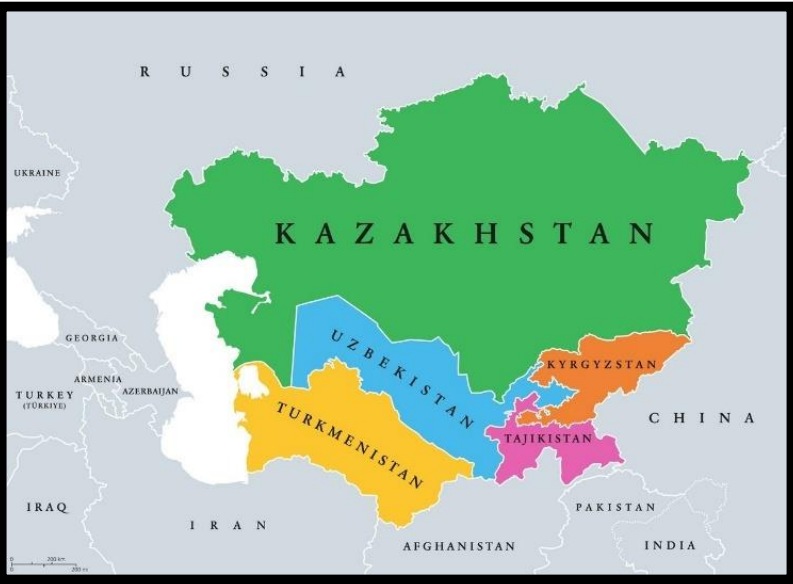
Central Asia Region
- Location: Located at the heart of the Eurasian landmass, bounded by Russia (north), China (east), Iran and Afghanistan (south), and the Caspian Sea (west).
- Members: Comprises 5 landlocked countries: Kazakhstan, Kyrgyzstan, Tajikistan, Turkmenistan, and Uzbekistan.
Key Pillars of the Relationship: –
- India and Central Asian states face common challenges: terrorism, drug trafficking, extremism, and regional instability (especially post-Taliban Afghanistan).
- India has conducted joint military training and counterterrorism exercises, especially with Kazakhstan, Uzbekistan, and Kyrgyzstan.
- Central Asia supports India’s membership in Shanghai Cooperation Organisation (SCO), which enhances regional security cooperation.
Energy and Natural Resources: –
- Central Asia is rich in hydrocarbons, uranium, and rare earths.
- India signed a civil nuclear cooperation agreement with Kazakhstan, which supplies uranium to India.
- Interest in TAPI Pipeline (Turkmenistan–Afghanistan Pakistan–India) for gas imports, although progress is slow due to security issues.
Connectivity and Trade: –
- Lack of direct land connectivity (due to Pakistan) is a key challenge.
- India invested in the Chabahar Port (Iran) and International North–South Transport Corridor (INSTC) to access Central Asia via Iran and the Caspian Sea.
- Central Asia is included in India’s Extended Neighbourhood Policy and Connect Central Asia Policy (2012).
Economic and Commercial Relations
- Bilateral trade remains below potential (~$2 billion annually).
- India offers Lines of Credit, grants, and training under the Indian Technical and Economic Cooperation (ITEC) program.
- India–Central Asia Business Councils set up to promote private sector engagement.
Cultural and People-to
- Cultural diplomacy rooted in Buddhism, Sufism, Hindi films, and educational scholarships.
- Indian Council for Cultural Relations (ICCR) supports cultural exchanges.
- Kyrgyzstan and Kazakhstan are major recipients of Indian medical and IT education services.
Multilateral and Regional Engagement
India is a member of:
- Shanghai Cooperation Organisation (SCO): Engages on security, economic, and cultural platforms.
- India–Central Asia Dialogue: Institutionalized since 2019, involving regular ministerial-level talks and working groups.
- India supports Afghanistan’s stability and has worked with Central Asia to ensure a non-extremist regienvironment.
Key Challenges: –
- Geographical disconnection: Pakistan’s denial of transit blocks direct land access.
- Low economic volume: Trade and investment remain modest despite potential.
- Security volatility: Instability in Afghanistan and parts of Tajikistan affects regional plans.
- Lack of Direct Land Access: India does not share a direct land border with Central Asia, making trade routes dependent on third countries like Iran, Afghanistan, or Pakistan.
- Geopolitical Competition: Central Asia is a region of strategic interest for major powers like China (through its Belt and Road Initiative), Russia, Turkey, and the EU.
- Low Trade Volume: Trade between India and Central Asia lies at a measly US $2 billion compared to China’s US $100 billion trade.
- Regional Security Concerns: Terrorism, radicalization, drug trafficking and instability in neighboring Afghanistan.
- Drug and Arms Trafficking: The proximity to the “Golden Crescent” (Iran-Pakistan Afghanistan) makes Central Asia susceptible to drug and arms trafficking, which can fuel instability and corruption.
- Bureaucratic and Regulatory Hurdles: Difficulties in visa issuance, customs clearances, and investment regulations.
Way Forward: –
- Strengthen INSTC and Chabahar to reduce dependency on unstable routes.
- Increase bilateral trade and private investment in sectors like pharma, IT, textiles, and agriculture.
- Promote digital and green partnerships, including solar energy cooperation under the International Solar Alliance.
- Enhance people-to-people exchanges, especially in education, health, and culture.
- Collaborate with Central Asia in countering radicalization and terrorism, leveraging shared concerns post-Afghanistan.
Conclusion: –
- The 4th India-Central Asia Dialogue underscores India’s growing strategic and normative engagement in Eurasia.
- C. Raja Mohan, a prominent realist scholar, argues that India’s outreach to Central Asia is part of its effort to achieve strategic depth and balance China’s Belt and Road Initiative.
- G. John Ikenberry, a leading liberal institutionalist, would interpret India’s emphasis on multilateral cooperation (ISA, CDRI, GBA) as a move toward rules-based regionalism. Collectively, the dialogue enhances India’s strategic autonomy and reinforces its leadership role in the Global South.
Mental Healthcare in India
Tags :
News Context (TH):
- According to the World Health Organization (WHO), untreated mental health issues lead to over $1 trillion in lost global productivity every year.
What is Mental Health?
- The WHO defines mental health as a state where individuals can realize their abilities, manage normal life stress, work efficiently, and contribute to their communities.
- The scope of mental health covers conditions such as anxiety, depression, bipolar disorder, and schizophrenia.
Mental Health in India: Key Statistics
- WHO estimates India’s mental health burden at 2,443(disability-adjusted life years) DALYs per 10,000 people.
- Around 15% of Indian adults suffer from mental health issues, with urban areas (13.5%) showing a higher prevalence than rural areas (6.9%).
- The lifetime prevalence of mental disorders in India is 13.7%.
- Note: Disability-Adjusted Life Year (DALY) measures the overall disease burden by adding years lost to premature death and years lived with disability. One DALY equals one lost year of healthy life.
Impact of Poor Mental Health: –
Productivity Loss:
• Decreased workplace performance, higher absenteeism, and lower efficiency.
Social and Emotional Impact:
• Affects relationships, confidence, and overall social well-being.
Economic Consequences:
• The economic cost of mental illness in India is projected at $1.03 trillion (2012–2030).
Challenges in Mental Healthcare: –
Treatment Gap:
• As per the National Mental Health Survey (2015–16), 70–92% of those affected do not receive care due to stigma, poor awareness, and inaccessible
services Shortage of Professionals:
• India has only 0.75 psychiatrists per 1 lakh population, far below the WHO benchmark of 3 per lakh, limiting access to proper care.
Stigma and Misconceptions:
• Social taboos discourage people from seeking help early.
Insurance Limitations:
• Many are unaware that mental health services are covered under insurance, especially OPD and cashless
services.
Urban-Centric Access:
• Infrastructure like clinics and specialists is mostly concentrated in urban centers.
Government Initiatives: –
Mental Healthcare Act, 2017:
• Grants equal status to mental and physical health, mandates insurance coverage, and protects the rights of those with mental illness.
National Mental Health Programme (1982) and District Mental Health Programme (1996):
• Focus on accessible and affordable community-based mental health services.
Tele MANAS:
• A national 24×7 tele-mental health service offering counselling, especially targeting remote and underserved regions.
National Suicide Prevention Strategy (2022):
• Aims to reduce suicides through awareness, early detection, and intervention.
Global Initiatives: –
Mental Health Action Plan (2013–2030):
• Offers a global framework to enhance governance, expand care access, and integrate mental health into basic healthcare systems.
World Mental Health Report 2025:
• Urges policy reform, stigma reduction, and a shift toward community and rights-based care.
Mental Health in Global Development:
• Recognized as key to achieving several Sustainable Development Goals (SDGs), including those
related to education, poverty, and gender equity.
Way Forward: –
Improve Insurance Access:
• Ensure full implementation of the Mental Healthcare Act and offer affordable, inclusive plans.
Increase Public Awareness:
• Launch mass campaigns to destigmatize mental health issues.
Enhance Digital Outreach:
• Use platforms like Tele MANAS and mobile apps to reach more people.
Strengthen Policy Oversight:
• The IRDAI must monitor insurers for transparency and service delivery.
Promote Workplace Support:
Way Forward: –
Improve Insurance Access:
• Ensure full implementation of the Mental Healthcare Act and offer affordable, inclusive plans.
Increase Public Awareness:
• Launch mass campaigns to destigmatize mental health issues.
Enhance Digital Outreach:
• Use platforms like Tele MANAS and mobile apps to reach more people.
Strengthen Policy Oversight:
• The IRDAI must monitor insurers for transparency and service delivery.
Promote Workplace Support:
• Require employers to provide mental health support through group insurance schemes.
Conclusion: –
- Mental health is an integral part of overall well-being and a key determinant of a productive and equitable society. Despite growing awareness, India continues to face a significant treatment gap, shortage of professionals, and persistent social stigma.
Government initiatives like the Mental Healthcare Act, 2017, Tele-MANAS, and the National Suicide Prevention Strategy mark important progress. However, as highlighted by the National Mental Health Survey (2015–16), sustained efforts are needed to decentralize services, ensure insurance coverage, and integrate mental health into primary care. A rights-based, inclusive, and community-driven approach is essential to bridge the urban-rural divide and fulfil India’s commitment to universal health coverage and SDG 3.
GDP Base Revision
Tags :
News Context: –
- The Ministry of Statistics and Programme Implementation (MoSPI) is in the process of revising the base year for calculating Gross Domestic Product (GDP).
About: –
- The base year will be updated from 2011–12 to 2022–23.
- Along with GDP, key economic indicators like the Index of Industrial Production (IIP) and the Consumer Price Index (CPI) will also be revised with a new base starting next year.
- A 26-member advisory committee, headed by economist Biswanath Goldar, has been set up to explore new data sources and suggest methodological improvements for the revised series.
- The committee will also work on aligning GDP calculations with other indices such as WPI, CPI, and IIP, particularly for assessing industrial growth.
- The updated GDP series is expected to be officially released on February 27, 2026.
What is a Base Year?
- A base year is a reference year used to compare economic indicators like GDP, inflation, IIP, and CPI.
- It acts as a point of comparison, where the index value is fixed at 100 to measure changes in subsequent years.
- For example, if the GDP in the base year 2011–12 is ₹100 lakh crore and rises to ₹150 lakh crore in 2021– 22, it indicates a 50% growth over the base year.
- Using a base year helps adjust for inflation and allows for an accurate assessment of economic growth across different time periods.
Need for Revision:
- To reflect structural changes in the economy.
o Example- Emerging of New Sectors of Services like Fintech - Update data sources and incorporate new economic activities (like digital economy, gig sector).
o Example- Data in digital form - Ensure relevance and accuracy of national accounts.
o Example- 2011-12 Base, has different product base - Incorporate emerging sectors such as fintech, e-commerce, and renewable energy.
- Reflect changes in consumption patterns, production techniques, and technological advancements.
- Provide a more accurate picture of income, savings, and investment trends.
Challenges in Base Revision:
- Delays in data collection and standardisation.
o Example- Lack informal sector data - Capturing informal sector and emerging sectors accurately.
- Harmonising multiple indices for coherent analysis.
o Recent mismatch in WPI and CPI
Significance:
- Ensures data reliability for policymaking and international comparisons.
- Reflects contemporary economic realities.
- Essential for better forecasting, planning, and investment decisions.
- Helps in monitoring SDG targets, government schemes, and macroeconomic health.
- Builds confidence among investors, researchers, and global rating agencies.
- Strengthens India’s position in global data reporting systems like IMF and World Bank.
Way Forward:
- Strengthen data infrastructure and timely surveys (NSSO, CSO).
- Include digital economy, start-ups, platform workers in estimates.
- Enhance transparency in methodology and public awareness.
- Ensure regular and periodic revisions to avoid outdated estimates.
- Promote use of big data and AI tools for real-time economic monitoring.
- Foster coordination among central and state statistical agencies for consistent data.
Conclusion:
- The revision of the GDP base year is a crucial step toward making India’s economic data more reflective of current. It ensures better accuracy, transparency, and comparability in economic assessments.
- According to MoSPI, this update will improve data alignment with newer sectors and digital tools, ensuring stronger foundations for evidence-based policymaking. As India moves toward becoming a $5 trillion economy, a robust and updated statistical system will be essential for credible planning, investment attraction, and international trust in India’s economic indicators.
Case Study- Misuse of Investigative Agencies for Political Ends
Tags :
News Context (ToI): –
The Aam Aadmi Party (AAP) accused the BJP-led government in Delhi of politically motivated misuse of the Anti-Corruption Branch (ACB), pointing to a secret FIR against former AAP ministers while omitting mention of officials who sanctioned projects in 2016–17—well before their tenure
Ethical Issues: –
- Abuse of Power: Using investigative bodies for partisan objectives damages the impartiality of institutions.
- Transparency & Accountability: Withholding the full FIR undermines public oversight and due process.
Case Study 2: Forged Medical Documents by a Constable
Tags :
News Context (ToI):
- A Junagadh head constable forged medical papers to skip duty during Kumbh Mela, claiming his wife was ill—document forgery later exposed by hospital records and travel data
Ethical Issues: –
- Integrity Violation: Document forgery contradicts basic ethical conduct for public servants.
- Breach of Trust: Deception betrayed institutional trust and public resource misuse.
Mains Question for Practice: -
Tags :
Question 1
- The real fertility crisis lies not in overpopulation but in unmet reproductive goals.” In light of the UNFPA’s 2025 report, examine the need for a rights-based approach to reproductive health and population policies in India. (10 marks)
Question 2
• “India’s engagement with Central Asia reflects a blend of strategic interests and civilizational outreach.” Critically analyse this statement in the context of the 4th India–Central Asia Dialogue. (10 marks)
Question3
- Explain the importance of updating the GDP base year for economic policymaking. What challenges are involved in ensuring an accurate revision in the context of India’s informal and digital economy? (15marks)
Question 4
- “Mental health is a critical yet neglected component of public health policy in India.” Discuss in light of recent government initiatives and WHO findings.