
July 2'nd Week
Print PDF
General Studies II
India and BRICS
Tags :
India and BRICS
News Context:
• Last year, five new members namely Egypt, Ethiopia, Iran, Saudi Arabia, and the United Arab Emirates have joined BRICS as full-time permanent members. However, Argentina has withdrawn.
• The XVII BRICS Summit 2025 in Rio, hosted by Brazil, marked a key moment in global multilateralism, with the Rio Declaration calling for a just, multipolar world under the theme “Strengthening Global South Cooperation for a More Inclusive and Sustainable Governance”.
• Theme – “Strengthening Global South Cooperation for a More Inclusive and Sustainable Governance”.
Key Highlights of the 17th BRICS Summit:
• Reform of global governance institutions (UN, IMF, WTO)
• Climate action and climate finance
• Artificial Intelligence (AI) governance and cooperation
• Terrorism and global peace
• Strengthening the Global South
BRICS Expansion:
• In 15th summit Egypt, Iran, Saudi Arabia, UAE, Ethiopia, and Argentina joined the BRICS fold, amplifying the group’s representation across the Middle East, Africa, and South America.
• The original BRIC members had two things in common: large economies, and high potential growth rates.
• The expanded BRICS-11 is a less coherent group; some are going through crises, and others are thriving. This could signal an expansion of the agenda beyond economics.
• January 6, 2025: Indonesia formally joined as a full BRICS member, becoming the 11th member of the bloc.
What is BRICS?
• BRICS is an acronym for the grouping of the world’s leading emerging economies, namely Brazil, Russia, India, China, and South Africa.
• In 2001, the British Economist Jim O’Neill coined the term BRIC to describe the four emerging economies of Brazil, Russia, India, and China.
• The grouping was formalized during the first meeting of BRIC Foreign Ministers in 2006.
• South Africa was invited to join BRIC in December 2010, after which the group adopted the acronym BRICS.
Share of BRICS:
• The BRICS brings together five of the largest developing countries of the world, representing 41% of the global population, 24% of the global GDP and 16% of the global trade.
Chairmanship:
• The chairmanship of the forum is rotated annually among the members, in accordance with the acronym B-R-I-C-S.
• India hosted the chair for the 2021 BRICS Summit.
Initiatives of the BRICS:
New Development Bank:
• During the Sixth BRICS Summit in Fortaleza (Brazil) in 2014, the leaders signed the Agreement establishing the New Development Bank (NDB – Shanghai, China).
• It has so far approved 70 infrastructure and sustainable development projects worth.
Contingent Reserve Arrangement:
• In 2014, the BRICS governments had signed a treaty on the setting up of the contingent reserve arrangement.
• The arrangement is aimed at forestalling short-term balance of payments pressures, providing mutual support, and strengthening the financial stability of the BRICS nations.
Customs Agreements:
• Customs agreements were signed to coordinate and ease trade transport between BRICS countries.
Launched of Remote Sensing Satellite:
• In August 2021, the five space agencies signed an agreement on the Cooperation on BRICS Remote Sensing Satellite Constellation.
BRICS Payment System:
• The BRICS nations are working towards establishing a payment system that can serve as a substitute for the SWIFT payment system.
• It is considered an alternative to the dollar-dominated payment system to reduce the dependence on the dollar-based system.
Common Currency:
• The BRICS leaders agreed to explore the possibility of creating a common currency for trade and investment among the BRICS countries.
• They tasked their finance ministers and central bank governors to study the feasibility and benefits of such a currency, which could reduce their dependence on the US dollar and other major currencies.
Objectives of BRICS:
Rejection of Emerging Global Binary Divide:
• India and other BRICS members reject the idea of an emerging global binary divide, which suggests a world characterised by two opposing and dominant powers, often likened to a new Cold War. They do not agree with this perspective and consider it short-sighted.
Assertion of Strategic Autonomy:
• BRICS members, including India, are emphasizing their commitment to asserting their strategic autonomy.
• This implies that they want to make independent decisions and policies on the global stage, rather than being aligned with any superpower or bloc.
Multipolar World Order:
• BRICS countries are advocating for a multipolar world order. They envision a world where power and influence are distributed among multiple major players rather than being concentrated in the hands of a few dominant nations.
Demand for Voice and Respect for Interests:
• BRICS member nations are demanding that their voices be heard and their interests respected in international affairs.
• This suggests a desire for a more equitable and inclusive global governance system where the concerns of emerging economies are taken into account.
Reasons for the BRICS Expansion:
• China’s strategic move for global influence.
• FOMO: Fear of missing out on a visible club.
• Limited options in other groups.
• Anti-western sentiment and Global South unity.
Significance of BRICS for India:
Multi-alignment:
• It is an issue-based alignment strategy, which aims to simultaneously participate and pursue its interests in multiple strategic and economic coalitions, such as the Quad and BRICS.
Reflect multidirectional foreign policy:
• It strengthens economic prosperity, technology advancements, research and innovation, norm influencing, and strengthening security.
Diplomacy:
• It allows India to pursue a development focused diplomatic engagement which aims at increasing the membership of BRICS.
Energy security:
• New Members with having large oil reserves.
Combating terrorism:
• BRICS emphasizes coordinated action and intelligence sharing among member states to combat all forms of terrorism without double standards.
Climate change financing:
• BRICS advocates for enhanced climate finance from developed countries while promoting sustainable development through its New Development Bank.
Geopolitical force:
• BRICS attempts to amplify non-traditional security threats and promote economic security within the forum.
Political push:
• It would be a political push against unfair coercive practices.
• European Union’s Carbon border tax Economic transaction and Unilateral sanction.
Strategic interest:
• It is the first in-person summit since the military standoff with China at the Line of Actual Control in 2020.
Challenges India Faces in its Engagement with the BRICS:
Balancing Rival Interests:
• India must balance its relations with China and Russia, which are increasingly seen as strategic rivals by the West.
• China’s rise poses a major challenge and threat to India’s security and interests, especially on issues such as border disputes, maritime security, trade imbalance, technology competition, and human rights.
• Russia’s involvement in the Ukraine war and its alignment with China have also raised concerns in India about its traditional partner’s reliability and credibility.
Protecting/Practicing and Advocating Democratic Principles:
• India must deal with Western normative expectations, without compromising its autonomy or sovereignty.
• India does not want to alienate or antagonize other countries in the global South, who may see merit in China’s or Russia’s efforts at expanding the membership or influence of non-western forums such as BRICS or SCO.
Managing Bilateral Differences:
• India has unresolved border disputes and strategic rivalry with China and Pakistan, which affect its relations with the BRICS.
• India also has divergent views from Russia on issues such as Afghanistan, Iran, and the Indo-Pacific.
Balancing China’s Dominance:
• China is the largest and most influential member of the BRICS, with its economic, military, and diplomatic clout surpassing that of the other four members.
• India must balance its interests and values with its need to cooperate with China on common issues within the BRICS framework.
Geopolitical Rivalries:
• India’s complex geopolitical relationships with some BRICS members, such as China and Russia, pose challenges to maintaining a united front on various global issues.
Coordination on Multilateral Platforms:
• While BRICS aims to reform global governance institutions, including the United Nations and the International Monetary Fund, member countries often have different priorities and approaches to these reforms.
Varied Security Concerns:
• BRICS member countries have diverse security concerns, ranging from terrorism and regional conflicts to cyber threats.
Shifting Global Alliances:
• As geopolitical dynamics evolve, some BRICS members may seek closer ties with countries or organizations outside the group.
• This can impact the cohesion and collective bargaining power of BRICS on the global stage.
• India sees BRICS as a “non-western” rather than an “anti-western” group, emphasizing the platform’s diversity of perspectives.
Challenges of BRICS Grouping:
Overlap with other groupings:
• There is a parallel grouping of democracies known as IBSA (India, Brazil, and South Africa), which can lead to overlap in mandates and pose a challenge for BRICS to manage.
Economic slowdown and trade disputes:
• The ongoing economic slowdown and trade disputes among member states can impact the group’s ability to achieve its objectives.
Geopolitical tensions:
• The BRICS countries have different geopolitical interests and have been involved in regional conflicts and disputes. For example, China’s BRI, ‘string of pearls’, and developments at the Indo-China border have raised tensions with India.
The dominance of three countries:
• The overwhelming influence of Russia, India and China could potentially hinder the ability of other members, such as Brazil and South Africa, to have a meaningful impact on the group’s decisions and direction.
Paradox of BRICS:
• Despite several achievements, it began to lose its sparkle. The group may have lost its mojo, but numerous nations want to be admitted, thus showing the paradox of BRICS.
BRICS Currency and De-Dollarization:
• In the 15th Summit of BRICS, Brazil’s President proposed the creation of a common currency for BRICS nations to reduce vulnerability to dollar exchange rate fluctuations.
• De-dollarization would require numerous global entities to independently adopt other currencies.
Criticisms Against BRICS:
Lack of Shared Vision:
• Western commentators have criticised BRICS for not having a clear and cohesive shared vision.
Being a “Talk-Shop”:
• It is seen as a platform where leaders from these countries engage in discussions but do not produce tangible results or solutions.
No Worthwhile Achievements:
• Critics argue that BRICS has not produced any substantial or significant achievements that would justify its existence as a bloc.
• They may contend that the group’s activities have not had a meaningful impact on global affairs or have failed to address key challenges effectively.
Conclusion:
• BRICS holds multifaceted importance for India, offering a platform for addressing geopolitical concerns, facilitating bilateral talks, and advancing economic collaborations.
• As the global landscape continues to evolve, BRICS remains a critical forum for emerging economies to engage and collaborate on key global challenges.
• The outcomes of this summit will not only impact the member nations but also shape the broader trajectory of international relations and cooperation.
Question for Practice:
Assess the role of BRICS in coming decade. Examine the challenges and benefits of expanding BRICS membership beyond its core group (15 marks, 250 words).
PYQs:
Compare the significance of IBSA and BRICS in the context of India’s multilateral diplomacy (UPSC Mains 2012).
India has recently signed to become a founding member of the New Development Bank (NDB) and also the Asian Infrastructure Investment Bank (AIIB). How will the role of the two Banks be different? Discuss the strategic significance of these two Banks for India. (UPSC Mains 2014).
World Trade Organization (WTO) Reforms: India’s Perspective and Global Imperatives
Tags :
News Context:
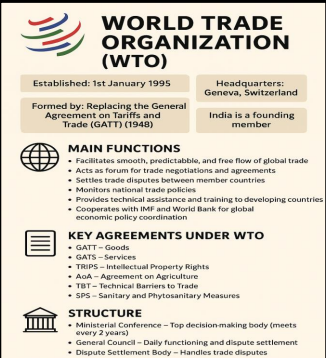
• India recently reiterated its call for meaningful reforms in the World Trade Organization (WTO) during a high-level mini-ministerial meet in Paris, ahead of the 14th WTO Ministerial Conference scheduled in Cameroon (2026).
India’s Key Reform Demands
Tackling Non-Tariff Barriers (NTBs): NTBs like technical standards, import licensing, and complex customs create artificial market barriers. India seeks greater transparency and monitoring mechanisms to curb such disguised protectionism.
Addressing Market Distortions from Non-Market Economies: Current WTO rules inadequately address issues arising from state-supported enterprises and opaque practices, particularly in countries like China.
Reviving the Dispute Settlement System: Paralysed since 2016 due to the U.S. blocking Appellate Body appointments. India has expressed reservations over the MPIA (Multi-Party Interim Appeal Arbitration), calling for a full restoration of the system.
India’s Broader Priorities at the WTO
Special and Differential Treatment (SDT): A Developmental Lifeline
India considers SDT a non-negotiable right for developing nations, not a concession. It provides flexibility in obligations, longer transition periods, and capacity-building support. India opposes attempts, particularly from developed nations, to introduce objective economic criteria that could restrict SDT access, as it may undermine structural realities of poverty, agrarian distress, and limited state capacity.
Resistance to Plurilateral Approaches (JSIs): Defending Multilateralism
India has refused to join Joint Statement Initiatives (JSIs), such as the Investment Facilitation for Development negotiations led by China and others. Concern: JSIs bypass WTO’s consensus-based process, risking fragmentation of the global trade regime and marginalisation of nations not party to such talks. India calls for issues of global significance to be discussed multilaterally, ensuring equity and transparency.Permanent Solution on Public Stockholding: Ensuring Food Security Sovereignty
India has long demanded a permanent solution to allow public procurement and stockpiling of food grains without violating WTO subsidy limits. Presently protected under the 2013 “peace clause,” India fears legal vulnerability if a permanent exemption is not secured. This is vital for India’s food security programmes like the National Food Security Act and PM Garib Kalyan Anna Yojana, impacting over 800 million citizens.Fisheries Subsidy Agreement: Seeking Equity in Conservation
India has withheld support for the 2022 Agreement on Fisheries Subsidies, citing lack of equity and ignorance of the Polluter Pays Principle. India seeks a 25-year transition under SDT for small-scale, traditional fishers dependent on livelihood fishing.
Other Significant Issues at WTO
• Development Status Disputes: Lack of objective criteria for classifying “developing” nations; USA opposes status claims by countries like China.
• Emerging Regulatory Shifts: EU’s Carbon Border Adjustment Mechanism and similar policies may burden developing economies with compliance costs.
• Geopolitical and Protectionist Trends: Examples include the US-China tariff war and strategic decoupling.
• New Issues in Global Trade: Data flows, digital taxation, and climate-linked trade obligations necessitate fresh multilateral approaches.
• Developing Country Status: The US and allies challenge the self-designation of ‘developing country’ status by nations like China and India, which grants them longer timelines and flexibilities.
• E-commerce and Digital Trade: Differences persist on data localization, customs duties on e-transmissions, and taxation of digital services. Developed nations push for liberalisation; India prefers a cautious, sovereignty-focused approach.
Way Forward
• Uphold inclusive decision-making, ensuring developing nations have proportional influence.
• Strengthen transparency through mandatory notifications and monitoring of NTBs.
• Ensure plurilateral negotiations remain non-binding and do not dilute the multilateral framework.
• Develop interim dispute mechanisms pending full revival of the appellate system.
• Establish rules for addressing industrial subsidies and state-owned enterprise advantages.
• Embed principles like “Common but Differentiated Responsibilities” to guide fair trade climate action.
Conclusion
As global trade enters an era of polycrisis, marked by fragmentation, protectionism, and emerging regulatory asymmetries, India’s call for WTO reforms is both timely and principled. Prime Minister Narendra Modi’s statement after the Rio BRICS Summit encapsulates this urgency: “BRICS is an organisation capable of changing itself with the times. Now we need the same resolve for reforms in institutions like the UN Security Council, WTO, and multilateral development banks.” India’s reform agenda isn’t merely transactional; it’s transformational. It calls for a WTO that is inclusive in structure, equitable in obligations, and transparent in decision-making.
Question For Practice:
India has reiterated its call for meaningful reforms in the World Trade Organization (WTO) to ensure fair and inclusive global trade. In this context, critically examine the challenges facing the WTO and discuss India’s priorities and role in shaping its reform agenda. (250 words)
General Studies III
Urban Maoism
Tags :
News Context:
• The Maharashtra Legislative Assembly on Thursday passed by a voice vote the stringent Special Public Security Bill, 2024 that seeks to tackle “unlawful activities of left-wing extremist organisations.”
Concept of Urban Maoism:
• Urban Maoism refers to the ideological, logistical, and support-based operations of Maoist insurgents (Naxalites) in urban and semi-urban areas, particularly among intellectuals, student bodies, NGOs, civil society, and academia. It is seen as a non-combatant front that works to further Maoist objectives through propaganda, recruitment, legal aid, and urban networks.
Objectives of Urban Maoism
Mobilization of Urban Masses
• Targeting students, workers, intellectuals, and NGOs to spread ideological support for Maoist insurgency.
• Creating front organizations to raise issues like human rights violations, tribal exploitation, and state violence, often to legitimize Maoist ideology.
Propaganda and Ideological Expansion
• Disseminating anti-state narratives, often in academic and media spaces, to influence public perception and weaken the legitimacy of the state.
• Publishing pamphlets, academic literature, or media content that subtly or overtly supports the Maoist worldview.
Fundraising and Logistical Support
• Using urban networks to raise funds, procure arms, recruit cadre, and transport communication equipment to rural guerrilla zones.
• Exploiting urban anonymity and institutional protection to act as conduits for supplies and strategy.
Legal and Political Shielding
• Influencing judiciary and legal systems to safeguard Maoist sympathizers or undertrials.
• Using human rights NGOs and PILs to pressure the government and slow counterinsurgency operations.
Recruitment and Radicalization
• Targeting youth in universities and urban slums for ideological indoctrination and future recruitment into armed cadre.
• Urban areas serve as incubation zones for educated recruits who can be deployed in both strategic and technical roles.
Strategic Coordination
• Urban cells often act as command-and-control centres for coordinating attacks, planning ideological strategy, and intelligence gathering.
Challenges of Urban Maoism
Infiltration into Civil Society and Institutions
• Urban Maoists often operate under the guise of intellectuals, activists, or NGOs, making it difficult for law enforcement to identify and act against them.
Radicalisation and Ideological Propaganda
• Urban cadres use digital platforms, student groups, and academic spaces to spread anti-state ideology and justify violence as resistance.
Recruitment and Urban Networking
• Cities are used as recruitment hubs to attract educated youth by exploiting social grievances (inequality, caste, land rights).
Funding and Logistical Support for Armed Cadres
• Urban Maoists act as financial and logistic arms of the rural insurgency — procuring arms, medical supplies, or communication tools.
Use of Constitutional Spaces for Subversion
• They exploit democratic rights such as freedom of speech and protest to carry out subversive activities, often shielding their violent intent.
Cyber and Media Warfare
• Urban Maoists manipulate public opinion by spreading misinformation through social media and alternative media platforms.
Legal and Human Rights Shield
• They often have access to legal expertise and human rights activists who challenge arrests and create a perception of state repression.
Way Forward
Intelligence and Surveillance Strengthening
● Strengthening multi-agency coordination (IB, NIA, State Intelligence units) to track urban Naxal networks.
● Deployment of open-source intelligence and cyber surveillance to monitor social media, academic forums, and NGOs suspected of radicalization.
Unlawful Activities (Prevention) Act (UAPA), 1967
● Used extensively to prosecute individuals or organizations found aiding or promoting Maoist ideology.
● Example: UAPA invoked against activists in urban centers for alleged links with CPI(Maoist), branding it a banned organization.
Urban Policing and Special Units
● Setting up special urban counter-insurgency cells within police departments (e.g., Maharashtra’s Anti-Naxal Operations cell).
● Use of quick response teams and cybercrime units to act on Maoist urban propaganda networks.
Monitoring of NGOs and Educational Institutions
● Government scrutiny of NGOs receiving foreign funds under FCRA (Foreign Contribution Regulation Act) if linked with radical left ideology.
● Example: Suspension of FCRA licenses of certain NGOs suspected to be ideological fronts.
Legal Reforms and Judicial Oversight
● Expedited trials through NIA Special Courts for cases involving urban Maoism.
● Regular reviews of prison inmates and bail petitions under stringent national security laws to balance rights and security.
Counter-Propaganda and Narrative Building
● Encouragement of civil society partnerships and academic initiatives to counter extremist narratives.
● Launch of campaigns on constitutional values, rights-based activism, and democratic dissent separation from violence.
● Example: Ministry of Home Affairs supporting counter-radicalization content on digital platforms.
Capacity Building and Training
● Training law enforcement in identifying ideological indoctrination strategies used by urban Maoists.
● Collaborations with think tanks and universities to study Maoist urban strategy.
Cyber Regulation and Content Monitoring
● Steps to flag and remove Maoist propaganda from social media and encrypted communication platforms.
● Collaboration with tech companies to restrict radical content.
● Example: Banning of certain YouTube channels and blogs linked with Maoist literature.
Rehabilitation and Surrender Policy Extension
● Extension of surrender and rehabilitation schemes to urban sympathizers who renounce violence.
● Example: Andhra Pradesh’s surrender policy includes deradicalization counseling for ideologically influenced urban youth.
Conclusion:
• Urban Maoism must be dealt with through a combination of firm law enforcement and democratic resilience. While it is essential to curb radicalisation and subversive activities through intelligence and legal mechanisms, care must also be taken not to stifle legitimate dissent and academic freedom. A calibrated state response rooted in constitutional values and inclusive development remains the key to neutralising such threats.
Question for Practice:
• Discuss the role of ideological propagation and urban sympathizers in sustaining the Maoist movement. Why is urban Maoism considered a serious internal security concern? (15 Marks, 250 words)
Disaster Management- Crowd Management
Tags :
Context:
• Recently, the issue of crowd management is in the news due to various incidents of stampede in different parts of the country such as Delhi railway station, Tirupati incident, and Prayagraj Kumbh Mela.
What is Crowd Disaster?
● Crowd disaster refers to loss of life, injury, or panic due to uncontrolled human congregation in confined or open spaces.
● Often results in stampedes, crushing, suffocation, or structural collapse during religious festivals (e.g., Kumbh Mela), political rallies, sports events, concerts, public protests, etc.
Causes of Crowd Disasters:
| Category | Causes / Examples |
|---|---|
| Structural | Inadequate entry/exit points; poor infrastructure; narrow passages and stairways; bottlenecks at choke points; weak or damaged structures (stages, platforms) leading to collapse. |
| Managerial | Lack of planning and contingency arrangements; poor on-site communication; insufficient or poorly trained crowd-control personnel; absence of signage, barriers and evacuation routes. |
| Psychological | Rumours and panic; fear of missing out (FOMO); herd behaviour and stampede mentality; emotional triggers during mass gatherings (e.g., sudden surge at a performance). |
| Environmental | Extreme heat or cold; poor ventilation; slippery or uneven floors; reduced visibility (smoke, dust, darkness); heavy rain causing slips or sudden movements. |
| Trigger Events | Fire, sudden collapse of a structure, panic caused by loud noises, accidental falls, unrest or aggressive crowd behaviour, or sudden rush during rituals/announcements. |
Key Components of Crowd Disaster Management
Pre-Event Planning
● Risk Assessment: Site analysis, route mapping, capacity estimation
● Crowd Modelling: Use of GIS and AI to predict human movement
● Permissions & SOPs: As per NDMA guidelines
● Infrastructure Readiness: Barricades, signage, PA systems, lighting
Stakeholder Coordination
● Unified Command Structure: Police, district admin, fire services, NDRF
● Training & Deployment: Trained marshals, volunteers, security personnel
● Inter-agency Mock Drills: Ensures coordinated response
Real-time Monitoring
● Surveillance Cameras & Drones for visual tracking
● Crowd Counting Systems (RFID, AI, heat maps)
● Communication Systems: Loudspeakers, SMS alerts, public address systems
Emergency Response
● Clear Evacuation Plan: Multiple entry/exit points
● First Aid Posts & Emergency Medical Teams
● Mobile Rescue Units
● Panic Control Measures
Post-Event Review
● Debriefing & Evaluation
● Identification of Gaps
● Policy and SOP Revision
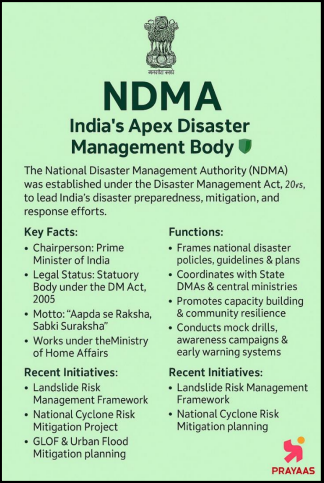
NDMA Guidelines on Crowd Management (2014)
● Issued after multiple religious stampedes.
● Key recommendations:
○ Mandatory event-specific risk assessments
○ Design of safe holding areas and exit plans
○ Use of technology and early warning systems
○ Deployment of incident commanders
Use of Technology
● GIS mapping for site planning
● AI-based crowd behaviour prediction
● Drones for aerial surveillance
● Portable barricade systems
● Command & Control Centres (CCC) with real-time data
Challenges in Crowd Disaster Management
Lack of Advance Planning and Risk Assessment
• Inadequate hazard mapping of venues (religious gatherings, political rallies, festivals).
• Failure to anticipate crowd size and movement patterns.
Poor Infrastructure and Design
• Narrow entry/exit points, lack of barricades or emergency evacuation routes.
• Insufficient signage and lighting in high-density areas.
Ineffective Crowd Monitoring and Surveillance
• Absence of real-time data analytics and surveillance tools like CCTV or AI-based systems.
• Inability to detect early signs of panic or overcrowding.
Limited Emergency Response Capacity
• Delayed medical response due to congestion.
• Lack of trained personnel for crowd control and emergency evacuation.
Coordination Gaps among Stakeholders
• Poor coordination between police, local administration, health services, and event organizers.
• Overlapping jurisdictions and lack of unified command.
Inadequate Public Awareness and Behavior Control
• Panic, rumor-mongering, and stampede-triggering behavior due to poor crowd psychology awareness.
• Non-compliance with guidelines and overcrowding due to emotional or religious fervor.
Technology Gaps
• Limited use of predictive modeling or GIS tools for crowd management.
• Weak mobile communication networks during high-density events.
Legal and Regulatory Challenges
• Absence of a comprehensive national policy or guidelines on crowd disaster management.
• Events held without safety audits or licenses.
Mass Gatherings in Informal or Unregulated Spaces
• Events like religious yatras and spontaneous protests often bypass safety regulations.
Post-Disaster Challenges
• Difficulty in identifying victims and managing crowd dispersal.
• Misinformation and social media panic aggravate the situation.
Best Practices
● Japan & Singapore: Automated people flow control in stations.
● Kumbh Mela 2019: AI-based crowd prediction and CCTV network.
● Mecca Hajj Management: RFID tracking and scheduled group movement.
● India’s Safe City Project: Crowd monitoring tech in urban areas.
Conclusion
• Crowd disasters, though often preventable, continue to pose a serious threat due to systemic negligence, poor planning, and lack of public awareness. Effective crowd management must go beyond reactive policing and adopt a proactive, technology-driven, and multi-agency approach.
Mains question for practice:
• Q. What are the primary causes of crowd-related disasters in India? Suggest short-term and long-term measures to prevent such incidents. (10 Marks,150 words)
Genetic Technology in Indian Agriculture: Promise, Paralysis, and the Path Ahead
Tags :
News Context:
• Indian agriculture, facing stagnating yields and growing pest resistance, urgently requires scientific innovation. Genetic technology, especially GM crops, offers a viable path forward, yet policy inertia and regulatory hesitancy have hampered its potential.
India’s GM Crop Landscape
GM Crop Policy
• Regulator: Genetic Engineering Appraisal Committee (GEAC) under the MoEFCC.
• Approved Crops: Only Bt cotton has received commercial clearance.
• Pending Approvals: Bt brinjal (moratorium since 2009), GM mustard (conditional clearance in 2022), HT-Bt cotton (no formal approval).
Bt Cotton: The Only Legal GM Crop in India
• Introduced in 2002, Bt cotton became India’s first and only approved GM crop.
• By 2013–14, it covered over 90% of India’s cotton cultivation area.
• Cotton production increased by 193% between 2002 and 2013–14.
• Gujarat recorded an 8% annual growth rate in cotton output during this period.
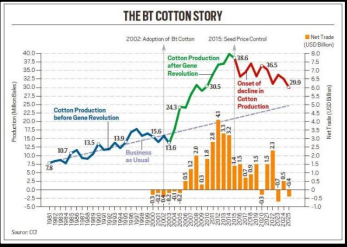
• India emerged as the second-largest cotton producer globally.
• Post-2015, yields declined from 566 kg/ha (2013) to 436 kg/ha (2022).
• Pink bollworm and other pests re-emerged, reducing Bt cotton effectiveness.
• Herbicide-Tolerant Bt (HT-Bt) cotton remains banned in India.
• Several countries continue using next-gen GM cotton variants commercially.
Broader GM Crop Approvals Stalled
• Bt Brinjal: Approved by GEAC in 2009 but placed under indefinite moratorium by the Environment Ministry in 2010 due to biosafety and public concerns.
• GM Mustard (DMH-11): Conditionally cleared by GEAC in 2022, but commercialisation is stalled. A 2024 Supreme Court split verdict questioned procedural gaps and referred the matter to a larger bench, further delaying deployment.
Global Opportunities India Missed by Not Adopting GM Crops
• Global Adoption Surged: As of 2023, 76 countries cultivate GM crops, with over 200 million hectares under GM cultivation (ISAAA).
• Declining Export Competitiveness: Countries like the USA, Brazil, and Argentina dominate global agri-exports through GM adoption, while India remains marginal.
• Yield and Input Losses: GM crops offer higher yields and pest resistance; India faces persistent low productivity and high pesticide dependence.
• Post-Bt Cotton Stagnation: India led with Bt cotton in 2002 but stalled further GM approvals (e.g., Bt brinjal, GM mustard), losing momentum.
• Erosion of Biotech Investment: Regulatory ambiguity has deterred domestic and foreign R&D investments in agricultural biotechnology.
• Paradox of GM Imports: India imports large quantities of GM soybean and canola oil, despite prohibiting domestic cultivation of the same crops.
• Weak Bargaining Power in Trade Talks: India negotiates trade deals under pressure to accept GM food imports without having GM export leverage.
• Missed Nutritional Interventions: GM crops like Golden Rice could address micronutrient deficiencies but remain blocked due to policy delays.
• Inadequate Response to Agrarian Stress: Without access to drought- and pest-tolerant GM varieties, Indian farmers remain exposed to crop failures and income shocks.
• Regional Leadership Forfeited: Countries like Bangladesh and the Philippines advanced with GM brinjal and Golden Rice, overtaking India in South Asia.
• Neglected Public Sector Innovation: Indigenous technologies (e.g., GM mustard by IARI) await approval, undermining public research efforts and scientific morale.
Key Reasons for India’s Hesitancy for GM Crop Adaptation
• Regulatory Inertia: India has not approved any new GM food crop for commercial cultivation since Bt cotton in 2002. Despite receiving expert-level clearance, GM mustard and Bt brinjal continue to face indefinite policy delays.
• Restrictive Policies: The Seed Price Control Order (2015) capped trait fees and slashed royalties, making the Indian market less attractive for innovators. Mandatory technology transfer clauses further deter global biotech investments.
• Public and Legal Resistance: Persistent activism, public interest litigations, and misinformation around health and environmental risks have created a climate of fear. The absence of science-based public communication has amplified distrust.
• Fragmented Governance: Lack of coordination between regulatory bodies like GEAC, the Ministry of Agriculture, and state governments creates confusion. The absence of a clear, unified regulatory framework discourages private sector engagement.
• Unchecked Illegal Cultivation: Herbicide-tolerant Bt cotton is cultivated illegally in several states without biosafety approval. Weak enforcement and absence of seed traceability compromise regulatory credibility and biosafety standards.
Key Concerns Behind Opposition to GM Crops
• Health Risks: Alleged links to allergies and long-term illnesses, despite lack of conclusive scientific evidence.
• Environmental Risks: Potential biodiversity loss and emergence of pest resistance due to prolonged GM crop usage.
• Economic Worries: High cost of GM seeds may deepen rural distress and increase farmer indebtedness.
• Corporate Control: Fears of monopolistic practices and IPR-related disputes, as seen in the PepsiCo potato case.
Way Forward – A Science-led Roadmap
• Develop a transparent, time-bound, and science-based GM crop approval system.
• Promote integrated pest management (IPM) and climate-resilient varieties.
• Encourage public sector R&D to reduce dependency on foreign biotech firms.
• Maintain non-Bt refuge zones to delay resistance.
• Monitor and curb illegal seed use while building a regulated framework for HT crops.
• Provide financial safeguards and crop insurance for biotech risks.
• Engage the public through awareness campaigns to address misinformation and ethical concerns.
Conclusion
• Prime Minister Modi’s call of “Jai Anusandhan” envisions an India driven by innovation—and nowhere is this more needed than in agriculture. As Atal Bihari Vajpayee once said, “What IT is to India, BT is to Bharat.” Biotechnology holds the promise not just of scientific advancement, but of transforming the lives of farmers, enhancing yields, and securing nutritional futures.
• By bridging the gap between lab and land, India can shift from GM crop hesitation to biotech leadership, making “Jai Kisan” and “Jai Anusandhan” not competing slogans, but complementary missions for a self-reliant and globally competitive Bharat.