
June 4'th Week
Print PDF
General Studies I
Geo-Atlantic Meridional Overturning Circulation
Tags :
News Context:
• Recent study shows that warming in the Indian Ocean may temporarily enhance AMOC strength, but long-term weakening remains a serious threat, with far-reaching consequences for Europe and Atlantic-bordering regions.
What is AMOC?
• The Atlantic Meridional Overturning Circulation (AMOC) is a critical component of Earth’s global ocean circulation system, responsible for large-scale movement of heat, salt, and carbon across the Atlantic Ocean.
• It is a thermohaline-driven conveyor belt that operates on a north-south axis and plays a pivotal role in regulating regional and global climate systems.
What is Thermohaline Circulation?
• Large-scale ocean circulation driven by global density gradients created by surface heat (thermo) and salinity (haline) differences.
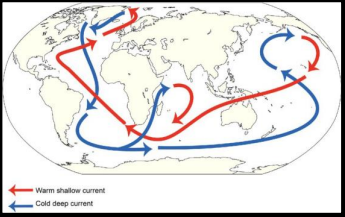
Process:
In polar regions, surface water becomes cold and salty (due to ice formation), increasing density.
Dense water sinks and flows towards the equator at deep ocean levels.
At lower latitudes, upwelling brings cold deep water to the surface, completing the loop.
Called the “global conveyor belt”, it connects all ocean basins and transports heat, salt, and nutrients worldwide.
Causes of Potential Collapse of AMOC
Melting of Greenland & Arctic Ice Sheets – Freshwater reduces salinity and density, disrupting sinking.
Increased Precipitation in North Atlantic – More rainfall & river discharge freshens surface water.
Surface Ocean Warming – Warmer waters are less dense, resisting sinking.
Changes in Wind Patterns – Shifts reduce northward transport of warm, salty water.
Reduced Sea Ice Formation – Less brine rejection → weaker density gradients.
Glacial Meltwater “Pulse” Events – Sudden discharge dilutes salinity abruptly.
Significance of AMOC
• Climate Regulation – Transfers heat from equator to higher latitudes, keeping Europe mild.
• Monsoon Impact – Influences Indian monsoon by altering SSTs and circulation.
• Marine Ecosystem Support – Nutrient cycling & productivity.
• Sea Level Control – Weakening raises sea levels along US East Coast.
• Weather & Extreme Events – Alters storm tracks, rainfall, and cold/heat events.
• Carbon Cycle Role – Deep-water formation acts as carbon sink, mitigating climate change.
Impact of Potential Collapse of AMOC
• Europe – Cooling, severe winters, reduced agricultural productivity.
• Global Rainfall – Shifts in monsoon belts; droughts & floods.
• Sea-Level Rise – Up to 0.5m rise along Eastern US coast.
• Extreme Weather – More heatwaves, storms, cold spells.
• Marine Ecosystems – Nutrient cycle disruption → fisheries decline.
• Carbon Cycle – Weak carbon sink → more CO₂ in atmosphere.
• Global Destabilization – Climate tipping point with cascading effects.
Way Forward
• Urgent Emission Reductions – Strengthen Paris Agreement targets.
• Protect Arctic & Greenland Ice Sheets – Mitigation through international cooperation.
• Strengthen Monitoring – Expand systems like RAPID array for early warnings.
• Advance Climate Science – Better models & regional assessments.
• Adaptation & Preparedness – Coastal defence, agriculture resilience.
• Public Awareness & Cooperation – Enhance global collaboration.
• Sustainable Ocean Policies – Marine conservation, reduce ocean pollution.
Conclusion
The AMOC highlights the fragile balance of our climate system. Safeguarding AMOC is essential not only for environmental protection but for global climate stability and sustainable development.
Question for Practice
What is the Atlantic Meridional Overturning Circulation (AMOC)? Discuss the mechanism of thermohaline circulation and its role in regulating regional and global climates. (10 marks, 150 words)
General Studies II
50 years of Emergency
Tags :
News Context
• The Union Cabinet has passed a resolution to mark the 50th anniversary of the Proclamation of Emergency, declared on June 25, 1975, under Article 352 of the Indian Constitution, citing internal disturbances.
Key Facts about Emergency
Background and Political Context
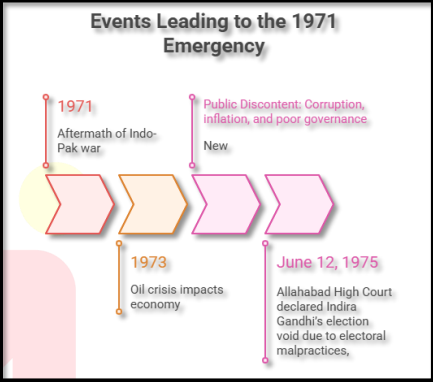
• Economic strain: Aftermath of the 1971 Indo-Pak war, successive droughts, and the 1973 oil crisis created economic distress.
• Public discontent: Corruption, inflation, and poor governance led to dissatisfaction.
• Student movements: Navnirman Andolan in Gujarat (1974) and JP’s Sampoorna Kranti movement mobilized mass protests.
• Judicial setback: On June 12, 1975, Allahabad High Court declared Indira Gandhi’s election void due to electoral malpractices, worsening the crisis.
Constitutional Amendments During the Emergency
• 38th Amendment: Barred courts from questioning the President’s decision to declare an emergency.
• 39th Amendment: Excluded PM and Lok Sabha Speaker’s elections from judicial scrutiny.
• 42nd Amendment: Expanded central powers, extended legislatures’ terms, and barred judicial review of constitutional amendments.
Reforms After the Emergency
• 44th Amendment: Replaced “internal disturbance” with “armed rebellion” as grounds for National Emergency.
• Restored judicial review of Emergency proclamations.
• Made parliamentary approval mandatory within one month with special majority for renewal.
• Strengthened protection of Articles 20 and 21 (personal liberty & protection against arbitrary arrest).
• Shah Commission (1977–79) investigated abuses during Emergency.
Types of Emergencies in Constitution
1. National Emergency (Article 352)
• Declared by President if security threatened by war, external aggression, or armed rebellion.
• Must be approved within one month; continues for six months with special majority for renewal.
• Suspends Article 19; Article 359 allows suspension of other rights except Articles 20 & 21.
2. President’s Rule (Article 356)
• Declared if state governance fails due to constitutional breakdown.
• Must be approved within two months.
• Central govt takes over state; legislature dissolved or suspended.
3. Financial Emergency (Article 360)
• Declared if financial stability or credit of India is threatened.
• Must be approved within two months.
• Centre controls state finances; can freeze salaries and direct fiscal policies.
Consequences of National Emergency on Constitutional Framework
Suspension of rights: Article 19 suspended; Article 359 suspends enforcement of other rights except 20 & 21.
Centralization of powers: Centre overrides states under Article 353.
Revocation of state autonomy: President’s Rule may dissolve/suspend state legislatures.
Judicial restrictions: 38th Amendment curtailed judicial review of Emergency proclamations.
Amendments & executive expansion: Govt could amend Constitution without judicial review (e.g., 39th Amendment).
Democratic functioning: Democratic processes weakened; balance of power disrupted.
Key Lessons from 1975–77 Emergency
• Safeguard civil liberties against government overreach.
• Place checks on executive power with judicial oversight.
• Ensure judicial independence for democratic norms.
• Maintain electoral integrity through transparency.
• Strengthen institutional safeguards for democracy.
• Promote public vigilance and accountability.
Conclusion
• The 1975–77 Emergency highlights the need to safeguard democracy and civil liberties. Ambedkar emphasized that emergency provisions should address exceptional circumstances but warned against misuse. The experience shows the importance of constitutional safeguards, judicial oversight, and public accountability to prevent erosion of fundamental rights.
Practice Question
2025 marks 50 years since the Proclamation of Emergency in India. Evaluate the lessons learned from the Emergency period. (10 marks, 150 words)
China in India’s Neighbourhood
Tags :
News Context
• China has revived trilateral engagements with Pakistan, Bangladesh, and Afghanistan to counterbalance India and strengthen its economic and security presence in South Asia.
China-Pakistan Nexus – Key Highlights
• Post-1962 realignment: After the 1962 war, China cultivated a strategic alliance with Pakistan to check India.
• Pakistan’s reliance: Pakistan depends on China for $29+ billion loans and 80% of arms imports.
• Diplomatic shield: China shields Pakistan at international forums, blocking action against terrorists.
• Operation Sindoor stance: China criticized India’s retaliation, backed Pakistan, and called for dialogue.
Strategic Objectives of China’s Trilateral Initiatives
• Elevate Pakistan’s role amid its crisis.
• Redirect influence to unstable regions (Afghanistan, Bangladesh) as Maldives, Nepal, Sri Lanka lean toward India.
• Expand Belt and Road Initiative (BRI) infrastructure and connectivity.
• Use Pakistan as a proxy to contain India’s rise.
Key Strategic Concerns for India
Terrorism threats: Pakistan may use Bangladesh and Afghanistan for cross-border terrorism with Chinese backing.
Strategic marginalization: India’s regional leadership and global support may decline.
Economic leverage: China’s financial dominance influences South Asian nations against Indian interests.
Encirclement (“String of Pearls”): Ports and military ties (Gwadar, Hambantota) restrict India’s IOR maneuverability.
Undermining connectivity: BRI challenges Chabahar, India-Myanmar-Thailand Highway, INSTC.
Sovereignty issue: CPEC passes through PoK, undermining India’s claims.
Northeast security: China’s role in Bangladesh and Myanmar could affect insurgency dynamics.
Strategic distraction: China’s moves in South Asia divert focus from LAC and Indo-Pacific.
Cyber warfare: Digital infrastructure entry risks surveillance and cyber manipulation.
Way Forward for India
Assertive diplomacy: Clearly state red lines and resist external reshaping of South Asia’s power balance.
Strengthen bilateral ties: Deepen cooperation with neighbours (Bangladesh, Nepal, Bhutan, Sri Lanka, Maldives).
Expand groupings: Promote BIMSTEC, IORA, BBIN as alternatives to BRI.
Boost connectivity: Speed up Chabahar, IMT Highway, INSTC to ensure autonomy.
Capacity building: Provide tech, aid, DPI, and skill-building to neighbours.
Security upgrade: Enhance naval power in IOR and border infrastructure against China-Pakistan axis.
Global leadership: Lead on climate, health, disaster relief, and SDGs to project benevolent power.
Soft power: Expand cultural exchanges, education, and digital diplomacy to build goodwill.
Conclusion
• The China-Pakistan nexus is an “axis of convenience” aimed at undermining India’s primacy through economic leverage, proxy politics, and encirclement. India must counter with smart power—strong regional partnerships, alternative multilateralism, and clear strategic red lines—while reinforcing its role as a stable and autonomous leader in South Asia.
Question for Practice
Discuss the strategic implications of the China-Pakistan nexus for India’s regional and global interests. Suggest measures India can adopt to counterbalance this evolving alliance. (15 marks, 250 words)
General Studies III
India’s Economy Amid Global Uncertainty
Tags :
News Context
• India is navigating global uncertainties—rising costs, disrupted supply chains, shifting trade policies—posing challenges for economy and exports.
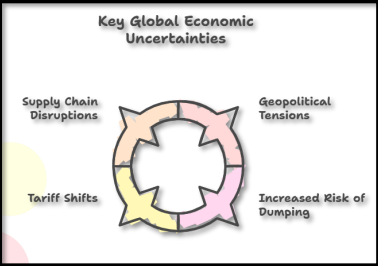
Key Global Uncertainties
• Geopolitical tensions: US-China trade war, Russia-Ukraine conflict disrupting global markets.
• Supply chain disruptions: Pandemic, logistics, disasters; China’s dominance in critical minerals adds pressure.
• Tariff shifts: US protectionism, EU carbon tax challenge exporters in textiles, electronics, pharma.
• Risk of dumping: Overproduction from China/ASEAN may flood India’s market with cheap imports.
India’s Strategic Resilience in the Face of Global Uncertainty:
• Resilient Growth Prospect: India has shown consistent growth, with real GDP projected to expand by 6.4% in FY25, maintaining its decadal average despite global disruptions.
• Fiscal Discipline: The government has adhered to fiscal consolidation targets, keeping the fiscal deficit under control while increasing capital expenditure to ₹11.21 lakh crore for 2025–26.
• Bilateral Trade Agreements (BTA): India has engaged proactively in trade talks with key partners, notably the U.S., to secure favourable agreements. Early and strategic Bilateral Trade Agreements, especially with the U.S., are intended to minimize tariff burdens on critical sectors such as services and manufacturing.
• Free Trade Agreements (FTAs): The conclusion of an FTA with the U.K. is a significant achievement. India is also pushing for other FTAs with the EU, Australia, and other critical partners, aiming to enhance market access for Indian exporters.
• Import Monitoring and Trade Safeguards: India has strengthened its import monitoring mechanisms to address the growing threat of dumping. The government has enacted trade remedial measures, including anti-dumping duties, to protect domestic industries.
• Public Capital Expenditure (Capex): India has focused on maintaining robust public capital expenditure to sustain domestic demand and create opportunities for private investments.
• Monetary Policy Support: The Reserve Bank of India (RBI) has kept its monetary policy accommodative, with a focus on controlling inflation while supporting economic growth through rate cuts.
• Attracting Foreign Investments: India has strategically targeted foreign companies seeking to diversify their supply chains from China and other countries. By positioning itself as an attractive investment destination, India hopes to strengthen its manufacturing base.
• Production-Linked Incentive (PLI) Schemes: The government has expanded the scope of PLI schemes to include more sectors like wearables, IoT devices, and raw materials for electric vehicle batteries. This aims to enhance India’s manufacturing capabilities and reduce dependency on imports.
India’s Challenges in Global Uncertainty:
• Dependence on the U.S. Market: India’s exports to the U.S. constitute a significant portion of its merchandise exports. Any change in U.S. tariffs directly impacts key sectors like apparel, pharmaceuticals, and electronics.
• Vulnerable MSMEs: India’s Micro, Small, and Medium Enterprises (MSMEs), which have a high reliance on exports, face the risk of unviable operations due to tariffs and non-tariff barriers.
• Inflationary Pressures and Rising Costs: Rising global commodity prices and logistical costs are putting additional pressure on industries, impacting margins and profitability.
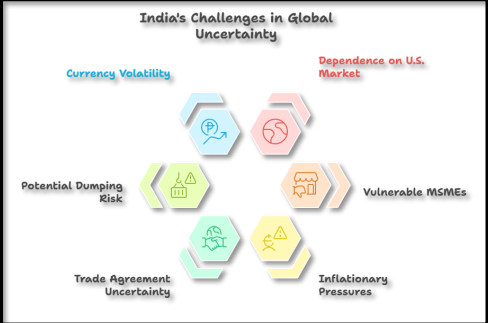
• Challenges in Trade Agreements: India faces uncertainty about the structure and impact of the trade deals it is negotiating with major partners, including the U.S., EU, and others.
• Potential Dumping Risk: The increased risk of cheap imports from China and other countries may lead to a market imbalance, undermining domestic production.
• Currency Volatility: Exchange rate fluctuations, exacerbated by global economic instability, impact India’s trade competitiveness, especially in sectors that are price-sensitive.
Way Forward:
• Diversify Trade Partnerships: Expand trade ties with emerging markets and secure favorable agreements to reduce dependency on traditional partners.
• Foster Domestic Resilience: Strengthen manufacturing, improve supply chains, and focus on export-oriented sectors to withstand global shocks.
• Build Sustainable Trade Frameworks: Develop long-term trade agreements that benefit India and promote global trade stability.
• Adopt Technology and Innovation: Invest in automation, digital infrastructure, and green technologies to enhance competitiveness.
• Targeted Policy Interventions: Focus on policies addressing inflation, cost pressures, and supply chain issues while attracting investment.
Conclusion:
• India stands as a rare “bright spot” in an increasingly uncertain global landscape, as noted by Chief Economic Advisor (CEA) V Anantha Nageswaran. The country’s consistent economic performance, despite ongoing global challenges, underscores its resilience and adaptability.
• As India sets its sights on becoming a $5 trillion economy by 2027 and establishing itself as a global manufacturing hub, this ambition requires more than mere growth—it demands strategic foresight, resilience, and the pursuit of autonomy in economic decision-making.
• In this evolving global order, India must transition from being a passive participant to an influential architect, shaping the future of international trade and global economic governance.
Question for Practice:
• “India is often described as a ‘bright spot’ amidst global economic uncertainty”. Assess the key policy measures that have helped India maintain Resilience in the Face of Global Uncertainty. (10 marks, 150 words)
Food processing Industry
Tags :
News context:
• Recently Minister for Food processing, Chirag Paswan highlighted that Food processing has become a force for grassroots transformation. The sector’s industrial growth is a testament to a rapidly evolving institutional and innovation ecosystem
What is the Food Processing Industry?
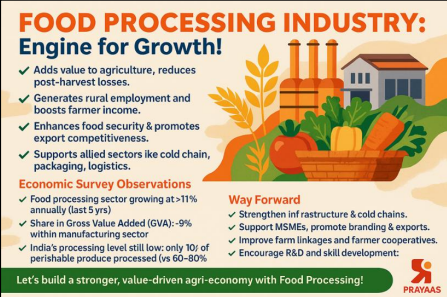
• Food Processing Industry involves converting raw agricultural products into consumable food items or value-added products through physical and chemical processes.
• Example: Turning tomatoes into ketchup, milk into cheese, wheat into bread, or fruits into packaged juices.
Objectives:
• Value Addition to Agricultural Produce: Enhance the economic value of farm products by converting them into processed goods (e.g., turning fruits into jams and juices).
• Reduce Post-Harvest Losses: Minimize wastage due to spoilage and inefficiencies in handling and storage.
• Improve Farmer Income: Provide better market opportunities and fair prices to farmers by creating demand for raw produce.
• Enhance Food Availability and Security: Produce convenient, fortified, and diversified food options, improving overall nutrition levels in the country.
• Promote Employment and Rural Development: Generate direct and indirect employment in farming, processing, logistics, and retail. Support rural infrastructure and small-scale enterprises.
• Encourage Export and Earn Foreign Exchange: Promote processed food exports to global markets, strengthening India’s trade balance.
• Support Development of Allied Sectors: Boost growth in cold storage, packaging, logistics, machinery manufacturing, and retail.
Data:
• According to the Economic survey-2024-2025, the food processing industry in India is one of the largest employers within organised manufacturing, accounting for 12.41 per cent of total employment in the organised sector. In the fiscal year FY24, the value of agri-food exports, constituting roughly 11.7 per cent of India’s total exports. Notably, the share of processed food exports within agri-food exports has risen from 14.9 per cent in FY18 to 23.4 per cent in FY24.
Significance of Food Processing Industry in India
Value Addition and Farmer Income:
• Converts raw produce into higher-value products (e.g., milk into cheese, tomatoes into puree), increasing returns for farmers.
• Supports government goal of doubling farmers’ income.
Reduction of Post-Harvest Losses:
• India loses ~30–40% of fruits and vegetables post-harvest due to inadequate storage and processing.
• Food processing reduces these losses and improves overall efficiency of the agricultural value chain.
Employment Generation:
• Labor-intensive sector providing direct and indirect employment in rural and urban areas.
• Supports employment in allied sectors like packaging, logistics, and cold chains.
Syllabus of Mains – GS-3: Food Processing and Related Industries in India- Scope’ and Significance, Location, Upstream and Downstream Requirements, Supply Chain Management.
Boost to Exports:
• Strengthens India’s position in global markets for processed goods (e.g., spices, ready-to-eat foods, frozen products).
• Generates valuable foreign exchange earnings.
Enhancing Food Security and Nutrition:
• Provides fortified, ready-to-cook, and diverse food options, addressing malnutrition and dietary gaps.
• Helps ensure year-round availability of perishable products.
Promotes Rural and Inclusive Development:
• Encourages establishment of processing units close to production areas, stimulating rural infrastructure development.
• Supports SHGs, FPOs, and small entrepreneurs.
Development of Supporting Infrastructure:
• Drives growth in cold storage, packaging, transport, and retail, modernizing India’s agri-supply chain.
Challenges of Food Processing Industry in India:
Fragmented Supply Chains:
• Highly dispersed farm holdings, poor aggregation, and lack of organized collection centers.
• Weak farmer-producer organization (FPO) networks.
Inadequate Cold Chain Infrastructure:
• Insufficient cold storage facilities, reefer vans, and pack houses.
• High perishability leading to post-harvest losses (up to 30–40% in fruits and vegetables).
Low Level of Processing:
• Only ~10% of perishable produce processed; very low compared to global standards.
• Value addition remains limited, affecting farmer income.
Regulatory and Compliance Barriers:
• Complex food safety standards (FSSAI norms) and multi-agency clearances.
• High cost of certification and compliance for small enterprises.
Credit and Financial Constraints:
• Limited access to institutional credit, especially for MSMEs and startups.
• High capital investment requirement; lack of risk-sharing instruments.
Lack of Skilled Manpower:
• Shortage of trained workforce in food technology, quality control, packaging, and logistics.
• Inadequate skill development programs tailored for processing sector needs.
Logistics and Connectivity Issues:
• Inefficient rural road networks, high transportation costs, poor last-mile connectivity.
• High logistics cost (about 13–14% of GDP).
Low Consumer Awareness:
• Limited demand for processed and fortified foods in rural and semi-urban markets.
• Preference for fresh produce over packaged alternatives.
Weak Branding and Global Competitiveness:
• Low focus on branding, marketing, and export-oriented standards.
• Limited global market penetration compared to competitors.
Policy Interventions & Government Schemes
Pradhan Mantri Kisan Sampada Yojana (PMKSY):
• Launched in 2017.
• Umbrella scheme to create modern infrastructure, reduce wastage, and improve supply chain efficiency.
Mega Food Park Scheme:
• Cluster-based approach to integrate farming, processing, and retailing.
• Provides common facilities like cold storage, testing labs, packaging centres.
Production-Linked Incentive (PLI) Scheme for Food Processing (2021):
• Aims to boost domestic manufacturing, brand building for global market.
• Focuses on ready-to-eat foods, processed fruits & vegetables, marine products, mozzarella cheese, etc.
Operation Greens:
• Initially targeted tomato, onion, potato (TOP crops).
• Now expanded to all fruits and vegetables.
• Supports price stabilization, reduces post-harvest losses, promotes value addition.
100% FDI Policy:
• Allowed under the automatic route for food processing and retailing of food products manufactured and/or produced in India.
• Encourages private investment and technological upgrades.
Skill Development Initiatives:
• Under PM Kaushal Vikas Yojana (PMKVY), specific modules for food processing workers.
• Focus on quality control, packaging, cold chain logistics.
Way Forward for Food Processing Industry:
Strengthen Backward Linkages:
• Promote Farmer Producer Organizations (FPOs) and cooperatives for better raw material aggregation.
• Encourage contract farming to ensure steady supply and fair prices.
Expand Cold Chain and Logistics Infrastructure:
• Invest in cold storages, pack houses, ripening chambers, and reefer vans.
• Improve rural road connectivity and reduce logistics costs.
Enhance Credit and Financial Support:
• Simplify access to institutional credit, especially for MSMEs and startups.
• Promote innovative financing models (e.g., blended finance, interest subvention).
Promote Skill Development:
• Strengthen skill development programs in food processing technology, quality control, packaging, and logistics.
• Partner with industry for hands-on training and upskilling.
Encourage Research and Innovation:
• Support R&D for new products, improved preservation, and processing techniques.
• Focus on health-oriented, fortified, and ready-to-eat products to meet changing consumer preferences.
Strengthen Regulatory Framework:
• Simplify FSSAI norms for small and medium enterprises while ensuring food safety.
• Promote single-window clearances for setting up new units.
Boost Branding and Market Development:
• Support domestic and global branding initiatives.
• Promote India’s traditional and indigenous processed food (e.g., millet-based products, ethnic ready meals).
Integrate with Export Markets:
• Develop export-oriented clusters, ensure compliance with global standards.
• Provide incentives for quality certifications and global market access.
Enhance Consumer Awareness:
• Promote benefits of processed and fortified food for nutrition security.
• Encourage demand for safe, hygienic, and convenient food products.
Conclusion:
• As Prime Minister Modi rightly said, “Food processing is a sunrise sector that can transform the rural economy.” With growing demand for value-added, nutritious, and convenient food, India must tap this sector’s full potential. Experts emphasize that strengthening farm-to-fork linkages, cold chain infrastructure, and global competitiveness can make India a world leader in agro-based industries, ensuring both farmer prosperity and consumer nutrition.
Question for Practice:
• Food processing is a sunrise sector with the potential to double farmers’ income and reduce post-harvest losses. Examine the role of infrastructure, innovation, and policy support in realizing this vision. (10 marks, 150 words)